Building Meaningful Inclusion: What Happens When Schools Listen to Students

Anne Hruska, Maxwell Palance, Wanzie Li, Hannah Poplack, and Sadie Giessner
Stanford Online High School
in Redwood City, California
Topics

Together, educators are doing the reimagining and reinvention work necessary to make true educational equity possible. Student-centered learning advances equity when it values social and emotional growth alongside academic achievement, takes a cultural lens on strengths and competencies, and equips students with the power and skills to address injustice in their schools and communities.
Meaningful inclusion means that students with disabilities and neurodivergent identities aren't just navigating the system, they are reshaping it with advocacy, community-building, and collaboration.
Introduction: Inclusion Requires More Than Good Intentions
At Stanford Online High School (OHS), conversations about inclusion often begin with a simple idea: meaningful inclusion requires thought, intentionality, effort, and collaboration.
Our school is somewhat unusual. We are a fully online private school serving students in grades 7–12 from around the world. Many of our students come to OHS because their local schools could not fully meet their academic needs. Many also identify as disabled, neurodivergent, or both.
Because of this, accessibility and belonging are not abstract concepts for us. They are everyday realities.
In a recent EDU Café conversation, we talked about how advocacy, community-building, and collaboration have changed our school over the past few years. Our experiences illustrate an important lesson for educators everywhere: student voices are essential to creating meaningful inclusion.
Advocacy Often Begins with Frustration
For many OHS students, advocacy began with personal frustration.
When Hannah Poplack arrived at OHS in eighth grade, accessibility was not always discussed openly. Students with disabilities sometimes struggled quietly with events or classroom structures that didn’t fully meet their needs.
Eventually, students began organizing.
What started with petitions, meetings, and a fair amount of “righteous rage” gradually evolved into more structured collaboration with teachers and administrators. Over time, student advocates became regular participants in conversations about accessibility.
Today, students are invited to contribute to staff training, event planning, and discussions about online learning strategies.
The process hasn’t been simple, but it has been meaningful.
Building Community through Student Groups
Two student organizations now play a central role in accessibility work at OHS:
The Neurodivergent Student Alliance
The Disability Culture Club
While the groups have different focuses, they collaborate closely.
According to student leader Sadie, one of the most important goals is normalizing conversations about disability.
Through school events, discussions, and shared advocacy projects, students are encouraged to talk openly about their experiences. These conversations help create a sense of belonging while also identifying areas where accessibility can improve.
Importantly, these groups are not only advocacy organizations; they are also communities.
Students support one another, share strategies, and learn how to navigate school together.
Visibility Matters, Especially Online
Online education removes some barriers but creates others.
For Wanzie, who uses a wheelchair due to a neuromuscular disorder, online learning eliminates many physical challenges associated with navigating a traditional campus.
But online environments can also make disabilities less visible.
When students appear only as small squares on a screen, much of their lived experience remains unseen unless they choose to share it.
Learning to speak openly about disability can be intimidating. Yet sharing those experiences has become a powerful tool for advocacy.
Students in the Disability Culture Club have created resource guides to help peers navigate accommodations, digital accessibility, college planning, and more. These guides offer both practical advice and a welcoming reminder: you are not alone.
Turning Community into Advocacy
For Sadie, accessibility work at Stanford Online High School began with finding community. As a new student, she became involved with the Neurodivergent Student Alliance, where she discovered that students could do more than navigate school systems; they could help improve them.
That experience led her to help revive the Disability Culture Club, creating a space where students could talk openly about disability, share experiences, and support one another.
One of the group’s key goals is to normalize conversations about disability. Through events like the Disability Experiences gathering, students share what it’s like to live with disabilities in school and in daily life, helping build understanding across the community.
For Sadie, one of the most important lessons has been realizing that accessibility concerns are rarely “just one person’s issue.” When students speak up, others often discover they are not alone and that their voices can lead to meaningful change.
Today, Sadie openly describes accessibility advocacy as one of her passions, and she hopes more students will recognize that they have the power to shape their communities.
Rethinking School Events
Accessibility also requires rethinking how school events are designed.
One example is the “quiet room” at in-person gatherings. At first, the idea seemed simple: provide a silent space for students who need sensory breaks.
But students quickly pointed out a flaw.
If the quiet room is located next to a loud dance, or if it is not properly supervised, it may not actually provide meaningful support.
Students worked with school staff to redesign the quiet room so that it truly functions as an accommodation rather than an afterthought.
They also helped introduce alternative social activities, such as nighttime flashlight walks, that allow students to participate in ways that suit different sensory and social preferences.
Interestingly, many students enjoy these alternatives, regardless of whether they identify as neurodivergent.
Accessibility improvements often benefit everyone.
Friendship and Belonging
For Maxwell, the online environment itself helped create opportunities for connection.
As an autistic student with a primary immune deficiency, traditional schooling had made forming friendships difficult. Online learning offered a different pace of social interaction.
Students can communicate through chat, take time to process conversations, and build friendships gradually.
Maxwell even started a Minecraft server for OHS students, which became a community space where friendships formed naturally.
These experiences challenge common misconceptions about neurodivergent students and social connection.
As Maxwell notes, many neurodivergent people deeply want friendships; they simply benefit from environments that make connection more accessible.
A Hope for the Future
Looking ahead, the students share a common hope: that accessibility will no longer be viewed as a niche issue.
Disability, injury, and changing abilities are part of the human experience. At some point in life, accessibility affects everyone.
When schools treat accessibility as a shared responsibility rather than a special accommodation for a few students, communities become stronger and more inclusive.
The work at OHS is ongoing. But one lesson has become clear:
When schools listen to students and work alongside them, meaningful inclusion becomes possible.
Listen
NGLC is grateful for our collaboration and partnership with EDU Café Podcast that brings fresh voices and insights to the blog. Listen to the full episode of the podcast that inspired this article.
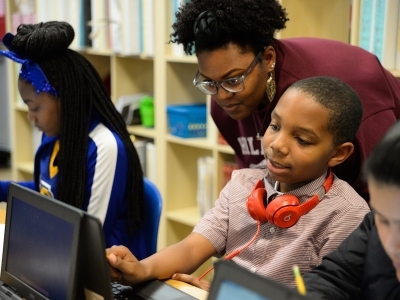
Photo at top courtesy of Stanford Online High School.
Anne Hruska, Maxwell Palance, Wanzie Li, Hannah Poplack, and Sadie Giessner
Stanford Online High School
Anne Hruska, Ph.D., is a senior English instructor and faculty sponsor of the Neurodiversity Student Alliance at Stanford Online High School.
Maxwell Palance is co-chair of the Stanford Neurodiversity Project’s Network for K-12 Neurodiversity Education and Advocacy, a NASA Neurodiversity Network N3 research intern and scholar, the developer of CODEversity, a USACO platinum level competitive programmer, the author of Typically Me, and a 2026 Davos Neurodiversity Summit Leadership Wall honoree.
Wanzie Li is a co-leader of the Disability Culture Club at Stanford Online High School, advocate with the Muscular Dystrophy Association, illustrator, and aspiring humanities researcher.
Hannah Poplack is a student at Stanford Online High School and San Jose State University who is autistic and has Tourette's Syndrome. She has led OHS's Neurodivergent Student Alliance for the past three years where she has collaborated on accessibility and education initiatives to improve the lives of neurodivergent and disabled students.
Sadie Giessner is a published author, award-winning computer scientist, data nerd, aspiring economist, public policy geek, and accessibility advocate who has led the student-run Disability Culture Club at Stanford Online High School for the past two years.