Possiblementando with New(er) Teachers in Developing Holistic Views of Self, Teaching, and Technologies
Mary Rice and Joaquín T. Argüello de Jesús
in Albuquerque, New Mexico
Topics
Educators are the lead learners in schools. If they are to enable powerful, authentic, deep learning among their students, they need to live that kind of learning and professional culture themselves. When everyone is part of that experiential through-line, that’s when next generation learning thrives.
Literacy is communal and cultural, and teaching is relational. When teachers hold onto community, celebrate small steps, and choose connections in learning, possibility stays alive.
Our stories of becoming educators began in very different places, yet they meet in the same commitments: caring for teachers’ well-being, centering relationships, and building community.
I (Mary) started teaching in the early 2000s, right in the midst of No Child Left Behind. My classroom was full of middle schoolers navigating English language arts, ESL, and reading support at a time when accountability measures seemed to swallow everything whole. I wanted to teach literature and language in ways that opened doors, but I also saw how quickly teacher wellness and student humanity could get buried under the pressure of test scores.
Meanwhile, I (Joaquín) was sitting in classrooms as a dyslexic Afro-Indigenous and Caribbean kid in New Mexico, often feeling like school wasn’t built for me. I didn’t see myself reflected in the lessons, and I often felt like I was being asked to leave parts of myself at the door. What got me through wasn’t the system; it was the relationships I had with community, family, and later with mentors who helped me see education differently. That experience eventually pulled me toward sociology, social work, and ultimately two decades of working with young people in schools.
Those experiences shape how we teach together now. When we step into a classroom with future educators, we don’t just talk about literacy or technology in the abstract. We ask our students to pause and reflect on their own schooling: Where did you feel excluded? Where did you feel celebrated? How can those memories guide the way you build your own classrooms?
We also invite them to see literacy as deeply connected to place. In New Mexico, literacy isn’t just about books or tests. It’s in the petroglyphs carved by Pueblo, Comanche, and Apache ancestors and in the knotted cords of the Pueblo Revolt. These traditions remind us that literacy is communal and cultural, and they challenge us to honor the knowledge systems that have too often been left out of schools.
For us, the idea of possiblementando, taking possibilities and making them real, has become a touchstone. Sometimes it looks like celebrating a student’s small breakthrough, or choosing to reframe a challenging moment, or even pausing to honor our own growth as educators. These micro-celebrations keep us grounded. They remind us that well-being doesn’t have to mean grand gestures; it often shows up in the little relational acts that carry us forward.
At the end of the day, what keeps us in this work is the belief that education is fundamentally relational. Teachers can only create thriving spaces for students if they themselves are supported, connected, and well. Our job with pre-service teachers is not just to give them strategies, but to nurture the hope that teaching can be sustaining, not depleting.
We know the challenges in schools are heavy, but we also know that when teachers hold onto community, celebrate small steps, and choose connections, possibility stays alive. And that’s what we want to model for our students, for ourselves, and for the communities we serve. We return again and again to this belief: relationships are the heart of education. When teachers feel supported, when their knowledge is honored, and when communities are centered, schools can become spaces of growth rather than exclusion. That is how we hold onto hope. And that is how we “possible-ize” a future where both teachers and students can flourish.
Listen: Possiblementando
NGLC is grateful for our collaboration and partnership with EDU Café Podcast that brings fresh voices and insights to the blog. Listen to the EDU Café episode with the authors to dive deeper into possiblementando—turning possibilities into action—and what sustains teachers and students.
*We wish to acknowledge the Center for Regional Studies at UNM for their support of revising the OER discussed in this webcast.
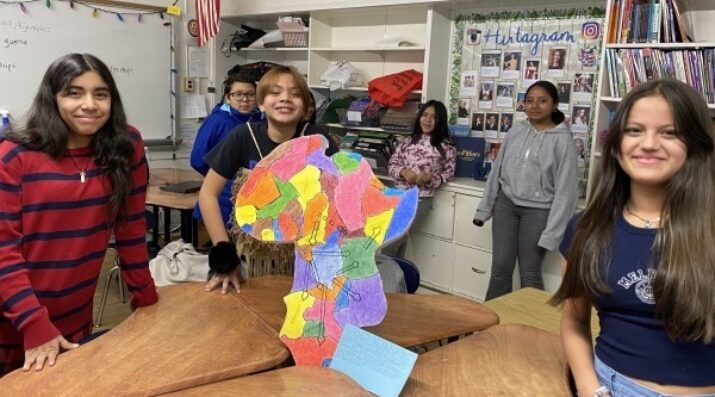
Photo at top courtesy of Hackensack Middle School. Credit: Dee Kalman and Amy Aguasvivas.
Mary Rice and Joaquín T. Argüello de Jesús
Mary Rice is an associate professor of literacy in the Department of Language Literacy and Sociocultural Studies at the University of New Mexico. Her research and teaching critique relational aspects of designing and doing inclusive digital learning. Recent honors for her work include the Diversity, Equity, and Inclusion Publication Award from the Innovations in Special Education Technology Division of the Council for Exceptional Children (2024) and the National Open and Distance Learning Award—K12 from the Open and Distance Learning Association of Australia (2025).
Joaquín T. Argüello de Jesús: Is a DominiXicanoRriqueño decolonial, antiracist, bilingual community, clinical, school social worker raised on the “Manito/a/x Trail” with board affiliations for the Arroyo Hondo Arriba Community Land Grant and Compostela Community & Family Cultural Institute and is a Ph.D. student in the Department of Language Literacy and Sociocultural Studies at the University of New Mexico doing graduate research co-facilitating bilingual math (Algebra) learning through Indigenous Epistemologies: “wonderment,” relationality, materiality, and Translanguaging corriente of 1st graders.