Technology Tools
CAST, Inc.
Universal Design for Learning Literacy in Physics ...


Educators increasingly rely on education technology tools as they shift instruction, redefine teacher roles, and design learning experiences that reflect how students actually learn. Technology should never lead the design of learning. But when used intentionally, it can personalize instruction, enrich learning environments, and help students master critical skills.
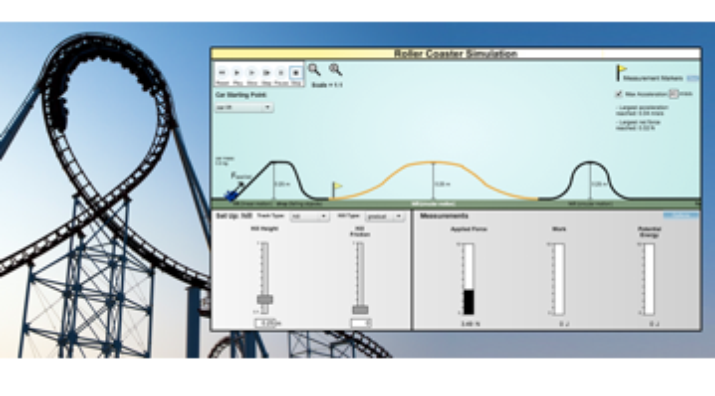
Real-life applications of course content resonate with students, creating deeper learning opportunities. The CoMPASS-Physics learning environment invites students to think like scientists and engineers when building an amusement park roller coaster over a 12-16 week period. Students work in teams in a technology-rich, interactive learning environment to accomplish the following:
Students write a roller coaster design proposal for their final project, reasoning like scientists and engineers as they argue for their plan’s safety, fun, and efficiency, and support their design decisions with physics explanations derived from collected data and information.
Common Core State Standards: English Language Arts Standards - Science and Technical Subjects:
Teacher Comments
"Overall I appreciate the rigor of the curriculum. Real science terms are used for real science work. The school [where] I teach [has] a gifted and talented curriculum. The students could breeze through two to three chapters of the textbook a day. But with this they had to stop, think, and work in groups."
"Students really developed science process skills—making a hypothesis, making observations, recording data, analyzing the information, drawing conclusions. Most student developed good working knowledge of experiments, setting up the last few experiments mostly on their own. I helped them a lot less than I did at the beginning."
Students’ pre- and post-tests showed the following significant gains:
With NGLC funding, the project team enhanced CoMPASS-Physics and created supporting training materials and programs. Approximately 1,200 sixth-eighth grade students used CoMPASS-Physics during the project.
Partners: