Want to Build Classroom Community? Get Sh*t Done!

Matthew Riggan (he/his)
Co-Founder
Workshop School
in Philadelphia, Pennsylvania
Topics
When educators design and create new schools, and live next gen learning themselves, they take the lead in growing next gen learning across the nation. Other educators don’t simply follow and adopt; next gen learning depends on personal and community agency—the will to own the change, fueled by the desire to learn from and with others. Networks and policy play important roles in enabling grassroots approaches to change.
When students experience competence in the classroom, they develop genuine connection, belonging, and a sense of community.
For almost as long as I have been writing about the Workshop School, I have argued that creating false distinctions between different types of learning undermines our work and does a disservice to students. All learning involves both thinking and feeling, and nearly all learning is social and interdisciplinary. As someone with a background in assessment, I get that we need to make choices about what we prioritize and what we measure. But the learning itself is far more intertwined and interdependent than common discourse would suggest.
We’re two weeks into our new school year. We are coming off a tough 2025-26 and welcoming a new cohort of ninth graders. So it’s no surprise that we’re heavily emphasizing building community and relationships. Everyone on our staff is bringing great energy into the classroom, running circle1 every day, and finding ways to learn more about, and connect with, students. But watching the work unfold, I am noticing an interesting distinction. Some folks appear to assume that community- and relationship-building precedes academic work, while others use academic work to build community and relationships.
I could easily imagine myself in the former category. We are not a behaviorist, carrots and sticks kind of school. The belief that we only get the best from students when they buy in is core to our mission, and it’s not a big stretch to assume that buy-in comes from interpersonal connection. The problem is that we don’t always ask the next question: where does interpersonal connection come from?
Routines like circle are foundational to community building, as are restorative practices (a broad term for a combination of mindsets, practices, and systems). They allow us to get to know each other better, practice listening and empathy, and seek the best in one another. But community building also comes through work. “We secure our sense of belonging,” psychologist David Yeager writes, “through experiences of looking competent in front of people whose opinions we care about—earned prestige.” The central thesis of Yeager’s work is that the need to belong, and to earn status and respect, is the primary imperative of adolescence. The key question, then, is what earns status and respect and therefore secures belonging?
Another psychologist, Carol Dweck offers a partial answer within a broader developmental theory of needs: feelings of belonging exist in a virtuous cycle with feelings of competence. The more competently we perform, the more we sense that we belong and vice versa. Whichever way the causal arrow is pointing, demonstrating competence is what affirms belonging.
It is important that we have routines and practices that communicate care, support, and healing. But if our goal is strong community and relationships, it is equally important that we provide frequent opportunities to earn that sense of belonging. The more students earn it, the more valuable the community becomes.
Reflecting on the needs of our new ninth graders, this connection between belonging and competence is leading me to some specific questions about both curriculum and teaching routines:
- When we plan do-nows, how do we make sure we acknowledge their completion and tie them to what follows?
- How do we reduce the scope of specific tasks or assignments so there are more opportunities to demonstrate competence?
- How do we honor accomplishment and make it visible without shaming the students who may be struggling?
- Where can we create opportunities for peer recognition?
- How can each work period end with a closing that both names and honors what got done that day?
How we design the work is buttressed by how we communicate about it. The tasks we give students need to challenge them—a super easy task that is praised lavishly feels like a participation trophy—but the challenge needs to be paired with communication about why we are challenging them, the belief that they can rise to it, guidance about how to do so, and the benefits of succeeding. Yeager and colleagues call these communications “belonging statements,” and have amassed an impressive body of research demonstrating their efficacy.
When we say the Workshop School promotes learning by doing, we generally mean experiential approaches like project-based learning, internships, or service learning. As we embark on another school year, my hope is that we can widen the lens a bit, and recognize that learning by doing applies to community and relationships as well.
1 At the Workshop School, students spend roughly half the day in interdisciplinary, project-based learning blocks called Advisories. The first project of each day opens with circle, which can focus on any number of different aspects of the school community.
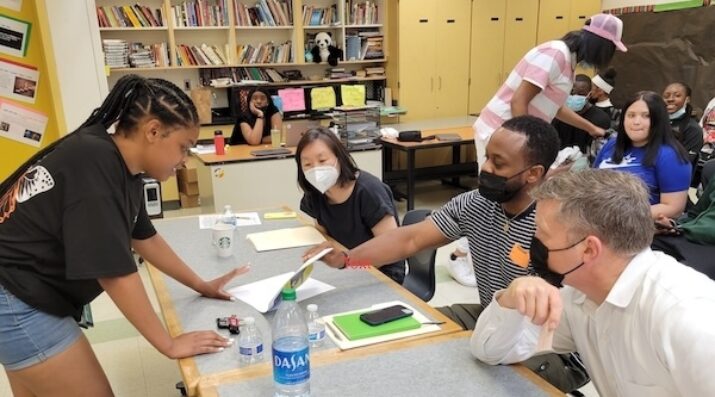
Photo at top courtesy of the Workshop School.
Matthew Riggan (he/his)
Co-Founder, Workshop School
Matthew Riggan is the co-founder of the Workshop School in Philadelphia, Pennsylvania.