Building AI Strategy in Schools

Justin Bruno
Director of AI Strategy & Innovation
Oakland Schools
in Michigan
Topics

Educators increasingly rely on education technology tools as they shift instruction, redefine teacher roles, and design learning experiences that reflect how students actually learn. Technology should never lead the design of learning. But when used intentionally, it can personalize instruction, enrich learning environments, and help students master critical skills.
To create an AI strategy for your school, consider how AI can create space for deeper thinking and stronger relationships to better serve your students, families, and community.
When I stepped into the role of director of AI strategy and innovation at Oakland Schools in Michigan, the position itself was brand new. That felt fitting. AI in education is new terrain for all of us. There is no comprehensive playbook. No universal implementation guide. No clean roadmap.
And yet, here we are; my team is supporting 28 school districts across Oakland County as they try to make sense of a technology that evolves by the minute.
If I’ve learned anything in this first stretch, it’s this: the goal isn’t to have all the answers. The goal is to build the capacity to ask better questions.
Start Your AI Strategy with People, Not Tools
There’s a lot of pressure to “move fast” with AI. Headlines make it feel urgent. Vendors make it feel inevitable. Social media makes it feel like everyone else is already ahead.
But schools aren’t tech startups. They are human-centered institutions built to serve students, families, and communities. That has to remain the anchor.
Before we talk about platforms or policies, I encourage districts to consider:
What problems are we actually trying to solve?
What needs are currently unmet?
How could AI help us serve people better, not just work faster?
AI should augment human expertise, not replace it. It should create space for deeper thinking and stronger relationships, not erode them.
Build Community, Not Silos, of Innovation
One of the first steps I took in this role was mapping where each of our 28 districts stood in their AI journey. Who had guidance in place? Who had task forces? What tools were being piloted? Who was leading the work?
That visibility allowed us to do something powerful: connect people.
We’re building a community of practice across districts in which leaders, teachers, and innovators learn alongside one another. In a rapidly shifting landscape, isolation is risky. Collaboration is stabilizing.
What we’ve learned so far: Some districts are experimenting with student-led AI advisory committees. Others are focused on foundational professional learning. Both approaches are valid. Context matters. Balance matters. Equity matters.
The Intersection of AI and Metacognition
AI can quickly become transactional. “Write this.” “Summarize that.” “Fix this.”
That’s useful but limited.
I’ve heard AI described as having the potential to serve three roles for us:
Clerk – Completing low-stakes, task-oriented work
Colleague – Offering feedback or alternative ideas
Coach – Helping us reflect, refine, and deepen our thinking
The more intentional we are, the more we move toward AI as a colleague or coach rather than just a clerk.
That shift requires metacognition, thinking about how and why we’re using the tool. It requires preserving our voice as well as checking for bias and inaccuracies. It requires not accepting the first answer as the final answer. AI literacy isn’t just about knowing how to prompt. It’s about knowing how to think.
Replace Urgency with Responsibility
Across our districts, leaders are starting from very different places. Some are piloting tools and receiving national attention. Others are just beginning foundational conversations.
My job isn’t to sell a silver bullet. It’s to help districts weave AI into their existing priorities, whether that’s improving school culture, addressing absenteeism, or strengthening instructional practice.
AI should serve those goals, not compete with them.
There’s also a deeper tension we must navigate:
If some students gain access to AI-supported learning and others do not, what new inequities are we creating?
We don’t solve that by rushing. We solve it by being deliberate.
Stay Curious, Stay Grounded
The AI landscape changes daily. New capabilities. New risks. New hype cycles.
To keep up, I curate information carefully. I follow researchers and practitioners in this space. I experiment. I even use AI to help me track AI developments. But I filter everything through one core question:
Does this meaningfully apply to schools right now?
Not every breakthrough in Silicon Valley translates to a classroom in Oakland County. Our job is discernment.
Embrace Productive Discomfort
This moment is uncomfortable. AI raises legitimate questions about work, authorship, creativity, and even identity.
But education has always required adaptability. Our responsibility isn’t to eliminate uncertainty. It’s to model how to navigate it.
If we can help educators and students build confidence, not mastery, not perfection, but confidence, in how AI fits into their lives, we will have done meaningful work.
Three years from now, I would love to ask every educator and student in our county:
“Do you feel like you understand AI well enough to have it serve you and not the other way around?”
If the answer is yes, we’re on the right path.
Until then, we’ll keep building thoughtfully, collaboratively, and always with people at the center.
Listen
NGLC, powered by LEAP Innovations, is grateful for our collaboration and partnership with EDU Café Podcast that brings fresh voices and insights to the blog. Listen to the full episode of the podcast that inspired this article.
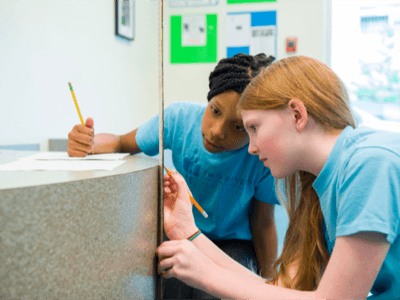
Photo at top courtesy of Da Vinci Schools
Justin Bruno
Director of AI Strategy & Innovation, Oakland Schools
Justin brings over 15 years of K-12 education and technology leadership to his role as the director of AI strategy and innovation at Oakland Schools in Michigan, where he leads county-wide efforts to build ethical, student-centered AI strategy, equip educators with training and resources, and position Oakland County as a leader in educational innovation.