Redefining Learner Profiles with AI

Katie O'Connor
Vice President and Academic Advisor
Distinctive Schools
in Chicago, Illinois
Topics
Educators increasingly rely on education technology tools as they shift instruction, redefine teacher roles, and design learning experiences that reflect how students actually learn. Technology should never lead the design of learning. But when used intentionally, it can personalize instruction, enrich learning environments, and help students master critical skills.
AI can move learner profiles from static snapshots to dynamic agency that empower students to lead their own narratives.
In the world of education, innovation is a constant state of adjustment. As our world evolves and emerging technologies shift the landscape of how we live and work, our approach to personalized learning must shift alongside it. At Distinctive Schools, we have always believed that delivering rigorous, personalized learning means leveraging data to identify needs sooner and accelerate student learning. However, how we personalize is evolving in a fundamental way. The goal is to move away from seeing students as data points to be managed and move toward seeing them as leaders of their own narratives.
Our history with learner profiles has been central to our model for over a decade. Starting as early as 2014, our educators were experimenting with ways to understand the "whole child"—going beyond test scores to include student aspirations and qualitative reflections. Throughout this time, we encountered a persistent challenge that many districts face: the limitation of static snapshots and documentation.
In those early years, profiles were often manual, time-consuming to maintain, and fragmented across different platforms. We found that without real-time synthesis, a learner profile becomes a snapshot of the past rather than a compass for the future. Teachers were often spending more time inputting data than actually using it to drive instruction. These profiles need to live and breathe through ongoing collaboration, or they become just another task for teachers rather than a reliable tool for student learning. We knew we needed to bridge the gap between knowing our students and empowering them to lead.
From Learner Profiles to Agency
This year, I had the honor of being selected for the 2025–2026 Google GSV Education Innovation Fellowship. This program unites a cohort of 32 leaders nationwide to work at the intersection of technology and instruction. The focus of my work through this fellowship—what we refer to as our Transformational Opportunity—was to evolve our learner profiles from static documentation into dynamic tools for student agency.
The goal was simple but bold: From Learner Profiles to Agency. To do this, we are leveraging AI so that a student’s identity, social-emotional strengths, and aspirations become the primary catalysts for their learning journey.
So, why AI? In the past, compiling a holistic view of a student required a heavy lift of manual data organization. By integrating AI tools like Gemini and NotebookLM, we can automate the mechanical process of gathering and synthesizing insights. Leveraging AI for learner profiles allows us to:
Synthesize Insights: We can transform fragmented, siloed data into coherent narratives without increasing teacher workload.
Increase Educator Capacity: When AI handles the data analysis, our teachers can gain back the most precious resource of all—time. Time to mentor, build relationships, and provide meaningful high-touch instruction.
Foster Student Voice: We have developed multi-format templates where students can use AI to help synthesize their own goals and learning preferences so that they have a voice in how their identity is represented.
We recently launched a pilot with all of our middle school classes as well as one third-grade class, where students are co-creating these AI-powered learner profiles. Instead of a teacher presenting data to a family, the students prepared to lead their own Family Conferences, using their profiles to drive the narrative of their own growth—learner agency begins when students move from being defined by data to leading with it.
While this pilot focused mostly on older students, our vision is a continuum of agency that begins the moment a student enters our schools.
Next Steps for Younger Learners: We are laying the groundwork for our youngest learners by focusing on learning identity. By helping students articulate their learning preferences and interests early on, we can ensure that the data we eventually synthesize in their AI profiles is built on a deep, authentic understanding of who they are from day one.
Strategic Growth: Our next network strategic plan involves making sure every learner has a dynamic, living document that prepares them for a future they choose. By incorporating this into our strategic plan, we are making learner profiles and personalized learning a top priority for our network.
How to Use AI with Learner Profiles
For districts looking to move toward dynamic learner profiles, you don't need a finished product to begin. Here is how you can start:
Define Your Data Schema: Look beyond academics and into what matters to your community. For instance, we focus on five key areas: Goals, Personal Context, Academics, SEL, and Learning Preferences. When CICS Longwood Elementary Principal Melinda Jean-Baptiste rolled this out school-wide, she framed the schema not as a compliance measure, but as a relationship builder. By intentionally capturing interests and hobbies, her staff moved from tracking what students completed to having deeper conversations about who students are.
Focus on AI Literacy: Supporting teachers to be AI-literate creators is essential for sustainable innovation. For the past year and a half, we have provided consistent training—from the network level to school-based workshops—for educators to see AI as a partner in personalization rather than a replacement for classroom interaction. When teachers feel comfortable with the technology, they can stop viewing it as a "new thing to learn" and start using it as a high-leverage tool to meet individual student needs.
Prioritize Voice and Choice: A profile is only powerful if the student owns the narrative. Start by asking students: "How do you want your identity to be represented?" We saw the culmination of this ownership during our recent Family Conferences. Principal Jean-Baptiste shared that as students used their profiles to lead the conversation, the shift was palpable; parents were moved to tears seeing their children articulate their own growth with such confidence and clarity.
As students continue leveraging their learner profiles, Principal Jean-Baptiste shared her hope for the future: that these profiles become a cumulative capstone of a student’s educational journey. Innovation is a journey of partnership—one that succeeds only when it strengthens human connection. When we move beyond static snapshots to dynamic agency, we equip students with the clarity and ownership they need to navigate a changing world. Our students are in the lead; our role is to ensure they have the tools and support to forge their path.
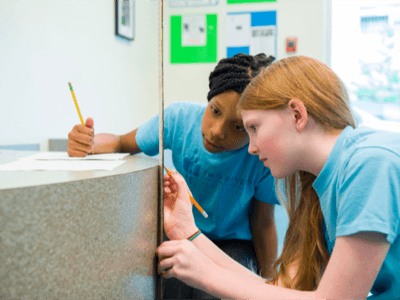
Photo at top of a middle school student at CICS Longwood Elementary, courtesy of Distinctive Schools.
Katie O'Connor
Vice President and Academic Advisor, Distinctive Schools
Katie O’Connor is the vice president and academic advisor at Distinctive Schools. Throughout her tenure with Distinctive Schools, Katie has served as an elementary educator, instructional coach, director of literacy, executive director of curriculum, instruction, and assessment, and the organization’s chief academic officer. She ensures instructional strategy is aligned to the mission and vision of Distinctive Schools and promotes investment in educators through design, collaboration, and professional learning. Katie brings a wealth of knowledge to educator development and is committed to investing in educators while fostering rigorous, engaging learning for all students.