From Classrooms to Communities: Why CTE Must Address the “Hidden Middle”

Christa Krohn, Betsy Franjola, Josiah Hannah, and Stefano Alva
Topics
Next generation learning is all about everyone in the system—from students through teachers to policymakers—taking charge of their own learning, development, and work. That doesn’t happen by forcing change through mandates and compliance. It happens by creating the environment and the equity of opportunity for everyone in the system to do their best possible work.
CTE programs that work with employers and economic development partners can not only prepare students for jobs but also design the conditions for those jobs to be accessible and sustained.
Career and Technical Education (CTE) has long been positioned as a bridge between education and employment. But what happens when students are prepared, including being skilled, motivated, and ready to work, and the opportunity still doesn’t materialize?
This is the challenge increasingly facing communities across the country: not a talent gap, but a systems gap.
The Misdiagnosis: Talent vs. System Design
For years, the dominant narrative has been that employers can’t find skilled workers. In response, education systems have doubled down on training, credentials, and career pathways.
But a growing body of on-the-ground experience suggests something different: We have ready people. We don’t always have ready places.
Even when students complete CTE programs, employers are hiring, and training aligns with industry needs, progress can stall due to factors that sit outside the classroom.
The “Hidden Middle” that CTE Often Misses
Between education and employment lies what can be called the hidden middle, the real-world conditions required to make work possible.
These include but are not limited to the following:
Reliable transportation
Affordable housing
Access to childcare
Healthcare stability
Water supply
Physical infrastructure (buildings, utilities, broadband)
Local policy and permitting realities
CTE programs traditionally focus on skill development. But skills alone are not enough if students cannot access or sustain employment due to these systemic barriers.
Preparation Takes Longer than We Admit
Another key insight for educators: true job readiness takes time, often far more than programs anticipate. In emerging or reintroduced industries (like advanced manufacturing or domestic textile production), regions may lack:
Existing expertise
Experienced trainers
Established career ladders
A 6–8 week training program may build foundational skills, but mastery can take months or even years of applied, on-the-job experience. For CTE leaders, this raises critical questions:
Are we designing programs for completion or for long-term success?
Do we have pathways beyond initial certification?
Who funds the “gap” between training and full productivity?
The Funding Gap: “Make-It-Possible” Dollars
Many promising workforce initiatives fail not because they lack vision, but because they lack flexible funding.
Traditional funding often supports:
Program launch
Curriculum development
Initial training
But what’s missing are “make-it-possible dollars,” or funding that:
Bridges the transition from training to employment
Supports wraparound services (transportation, childcare, healthcare)
Allows for longer-term skill development
Absorbs the risk of building new systems in underserved regions
Without this, even the best-designed CTE programs can struggle to scale.
When Systems Work against Students
In some cases, systemic barriers are not just logistical; they are structural.
For example, students who begin earning income may unintentionally reduce their household’s eligibility for essential benefits. Families may face financial instability as a result of a student’s success. These unintended consequences create difficult trade-offs and can discourage workforce participation, which is the exact opposite of what CTE aims to achieve.
Rethinking the Role of CTE
If we accept that workforce readiness is a systems challenge, then CTE must evolve beyond being a pipeline.
Instead, CTE can become a convener of cross-sector partnerships; a translator between education, industry, and community needs; and a co-designer of local economic ecosystems. This means working alongside employers, economic development organizations, community-based nonprofits, and policymakers to ensure that when students are ready, the system around them is ready too.
Designing for Reality, Not Just Readiness
The future of CTE lies in expanding its scope, not just preparing students for jobs but also helping design the conditions where those jobs can exist and be sustained. Because the real goal isn’t just placement; rather, it’s long-term prosperity for individuals and communities alike.
Listen
NGLC is grateful for our collaboration and partnership with EDU Café Podcast that brings fresh voices and insights to the blog. Listen to the full episode of the podcast that inspired this article.
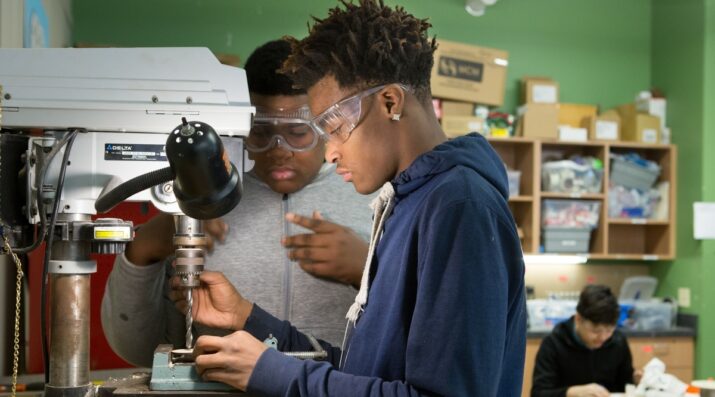
Photo at top by Allison Shelley/The Verbatim Agency for EDUimages
Christa Krohn, Betsy Franjola, Josiah Hannah, and Stefano Alva
Christa Krohn is the executive vice president of social enterprise and strategy at Future Plans, where she leads initiatives focused on workforce development, AI, education, and community-centered innovation to expand opportunity and eradicate poverty across rural and underserved communities.
Josiah Hannah is the workforce development director at Coalfield Development Corporation, which provides paid workforce training and apprenticeship to people entering or re-entering the workforce through social enterprises that are also rebuilding Appalachian places and prosperity.
Betsy Franjola is the founder of Hocking Hills Garment Center, an Appalachian-based apparel manufacturer focused on ethical production, workforce development, and rebuilding the domestic textile supply chain in Southeast Ohio.
Stefano Alva is the director of operations at Vitruvian, where he leads the deployment of advanced construction and manufacturing technologies alongside workforce development initiatives designed to train the next generation of skilled workers.