The AI Amplification Effect in K–12 Education: Why Understanding Work Styles Matters More Than Ever

Michelle Riconscente
Learning Scientist, Tech Founder, and Author
Topics

Next generation learning is all about everyone in the system—from students through teachers to policymakers—taking charge of their own learning, development, and work. That doesn’t happen by forcing change through mandates and compliance. It happens by creating the environment and the equity of opportunity for everyone in the system to do their best possible work.
When educators, administrators, and students begin to use AI, their work styles, strengths, and stress become more pronounced, impacting whether AI supports or disrupts teaching and learning.
As artificial intelligence becomes more embedded in K–12 education, much of the conversation has focused on tools, policies, and access. These are important. But they miss a critical truth: AI does not replace the human element in education; it amplifies it.
In my work as a learning scientist, I’ve seen that when educators, administrators, and students begin using AI, their natural ways of working, their strengths, and their stress patterns become more pronounced. Understanding this dynamic is essential if we want AI to support, rather than disrupt, teaching and learning.
The Four Work Styles in Schools
Decades of research in organizational psychology identified four primary work styles based on two dimensions: assertiveness (tell vs. ask) and responsiveness (task vs. people focus). These styles show up clearly in K–12 environments:
Analytical: Thoughtful, detail-oriented educators who carefully consider risks and implications. Often strong in curriculum design and assessment planning.
Driver: Action-oriented leaders and teachers who push initiatives forward and prioritize efficiency and results.
Expressive: Visionary thinkers who bring creativity, innovation, and new instructional ideas into the classroom.
Amiable: Relationship-centered educators who prioritize student well-being, collaboration, and community.
Every school needs all four.
The key insight is not which style is “best,” but how effectively individuals adapt their style to others.
What Changes When AI Enters the Classroom?
AI introduces a new dynamic: it reduces friction. Teachers can draft lesson plans, analyze data, and generate materials faster than ever. Students can brainstorm ideas, receive feedback, and explore concepts independently. But this efficiency comes with a tradeoff: fewer natural guardrails.
In traditional collaboration, colleagues provide balance:
The analytical teacher asks, “Have we thought this through?”
The driver says, “Let’s move forward.”
The amiable asks, “How will this impact our students?”
The expressive says, “What’s possible here?”
When working with AI, those balancing voices may be absent.
As a result, each person’s natural tendencies can expand unchecked.
The AI Amplification Effect in K–12
This is what I call the AI Amplification Effect: AI magnifies both our strengths and our stress responses.
In schools, this can look like:
An analytical teacher getting stuck in “analysis paralysis” when evaluating AI tools.
A driver administrator pushing rapid adoption without sufficient teacher input.
An amiable staff member agreeing to new initiatives without voicing concerns.
An expressive educator generating more ideas than a team can realistically implement.
These behaviors are strengths in overdrive.
Recognizing them as such is the first step toward more effective collaboration.
Reframing “Resistance”—or “Recklessness”—in AI Adoption
One of the most common challenges in K–12 AI adoption is perceived resistance. But what if the response that looks like resistance is actually a strength under stress?
Hesitation may be analytical risk awareness.
Pushback may be a need for relational trust.
Rapid action that feels reckless may be a desire to create momentum.
When leaders interpret these behaviors correctly, they can respond more effectively:
Provide clarity and criteria for analytical thinkers.
Create space for input and trust-building for amiable team members.
Channel expressive ideas into structured innovation.
Help drivers slow down just enough to bring others along.
Practical Strategies for Educators and Leaders
Here are a few ways schools can apply this framework immediately:
1. Define “Done” in Advance (Especially for Analytical Teams)
When evaluating AI tools or piloting new initiatives, clearly define success criteria upfront. This prevents over-analysis and helps teams move forward with confidence.
2. Use AI to Clarify Thinking (For Drivers)
If you’re moving quickly, pause to ask AI to help refine your question or goal. Better inputs lead to better outputs and better decisions.
3. Build Trust before Implementation (For Amiable Teams)
Adoption succeeds when people feel heard. Create structured opportunities for teachers to share what’s working and what isn’t.
4. Practice Creative Triage (For Expressives)
Encourage innovation and categorize ideas:
Breakthrough
Interesting
Exploratory
Focus team energy on the breakthrough ideas that align with school priorities.
Keeping Humans at the Center
The promise of AI in education is not just efficiency. It’s the potential to better support human learning and connection. But that only happens if we remain intentional.
When schools understand how people work, not just how technology works, they create environments where:
Teachers feel supported, not overwhelmed
Leaders make balanced decisions
Students benefit from both innovation and stability
AI doesn’t determine outcomes. People do. And when we understand ourselves and each other more deeply, we can ensure that AI becomes a tool for amplification of our best not our stress.
Listen
NGLC is grateful for our collaboration and partnership with EDU Café Podcast that brings fresh voices and insights to the blog. Listen to the full episode of the podcast that inspired this article.
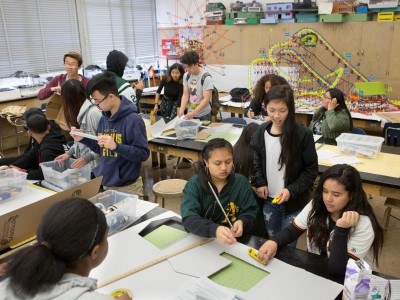
Photo at top by Allison Shelley/The Verbatim Agency for EDUimages, CC BY-NC 4.0
Michelle Riconscente
Learning Scientist, Tech Founder, and Author
Michelle Riconscente, Ph.D., is a learning scientist, tech founder, and author specializing in AI solutions grounded in behavioral and learning science. Follow Michelle on LinkedIn.