Beyond the Pencil: Using AI to Bridge the Gap for 2nd Grade Writers

Kristen Liedtke
Educator, Coach, Mentor
Modern Classrooms Project
in Troy, Illinois (Greater St. Louis Area)
Topics
Educators increasingly rely on education technology tools as they shift instruction, redefine teacher roles, and design learning experiences that reflect how students actually learn. Technology should never lead the design of learning. But when used intentionally, it can personalize instruction, enrich learning environments, and help students master critical skills.
Using AI tools through the lens of Universal Design for Learning (UDL) can remove structural barriers of writing that get in the way of students' expression and demonstration of learning.
Meet Parker. If you talked to her for five minutes about Siberian Huskies, you’d think you were speaking to a miniature dog trainer. She can tell you why they have double coats, how they "talk" instead of bark, and why they were the heroes of the Great Race of Mercy in Alaska. Her brain is a library of vivid, exciting information.
But then, it’s time for writing.
The Hidden Complexity of the "Simple" Sentence
To an adult, writing a sentence feels like one smooth motion. To a second grader, it is a high-wire act of multitasking. Writing is one of the most complex cognitive tasks we ask of young children. It requires the simultaneous coordination of:
Transcription: The physical mechanics of grip, letter formation, and staying inside the lines.
Encoding: The phonetic process of spelling words.
Grammar & Syntax: Following the rules of sentence structure and punctuation.
Ideation: Holding a complex thought in the mind while the hand tries to keep up.
For many learners, especially those with disabilities, these components are not integrated; they are in competition. For Parker, the physical act of forming a letter ‘H’ takes up 100% of her available brain power. When the mechanics are this heavy, the ideation—the actual "learning" part—is the first thing to be sacrificed. The moment her fingers grip that yellow pencil, the library doors of her mind slam shut.
In my classroom, I’ve realized that if we insist a child must climb a mountain of mechanics just to show us they know what a mountain is, we aren't testing their knowledge; we are testing their endurance. For students with dysgraphia, ADHD, or processing delays, these mechanical "stairs" are a structural barrier. My goal is to build a bridge that lets their ideas cross over, even while their hands are still learning the ropes.
Enter the "3 Word Wonder"
To dismantle this barrier, I started using a tool I built in MagicSchool called the 3 Word Wonder. The goal is simple: take a heavy, academic definition and strip away the "linguistic noise" that triggers a student's shutdown mode.
For a student like Parker, a traditional definition of a working dog ("A canine that is not merely a pet but is trained to perform tasks to assist its human companions") is a brick wall. With the 3 Word Wonder, the AI does the heavy lifting:
The Word: Working Dog
The Wonder: Dogs with jobs
The Hook: 🐕🦺
Leveling Up: Talk-to-Text and Text-to-Speech
The 3 Word Wonder gives Parker the concept, but AI-powered assistive tools give her a voice.
Text-to-Speech (Hearing the Ideas): If Parker struggles to decode the words on the screen, she clicks a button. The auditory reinforcement confirms she’s on the right track without exhausting her mental energy on phonics.
Talk-to-Text (Sharing the Ideas): When it’s time to explain why Huskies are work dogs, Parker doesn't reach for the pencil. She taps the microphone and says, "Huskies are working dogs because they pull sleds across the snow." Suddenly, the screen fills with her thoughts. The "transcription trap" is dismantled.
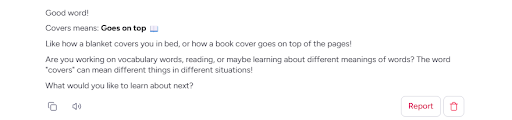
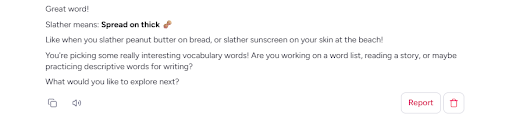
Examples of student work using the 3 Word Wonder tool
Why This AI-Based Support Is a "Ramp," Not a "Crutch"
In the world of Universal Design for Learning (UDL), we talk a lot about "removing the barrier." If a student can’t walk up stairs, we don’t tell them to "try harder"—we build a ramp.
Using AI to simplify vocabulary or transcribe a story isn’t "cheating." It’s a digital ramp. When Parker sees "Dogs with jobs 🐕🦺," she isn’t spending five minutes decoding a 15-word sentence. She gets the concept in two seconds, and suddenly, she’s back in the game. She isn't spending her energy on the act of reading; she's using it for the joy of learning.
MagicSchool: My Personal "Construction Crew"
If UDL is the blueprint for my classroom, MagicSchool is my personal construction crew. As a Special Education teacher, I am often stretched thin trying to differentiate one lesson for ten different learning profiles.
MagicSchool doesn't replace me; it removes my administrative and cognitive load. I can take a complex science article about Huskies and, with one click, level the text down or generate a list of "3 Word Wonders." It allows me to turn a one-size-fits-all curriculum into a custom-fit experience.
For example, when a student faces "Blank Page Syndrome"—that paralysis caused by a failing executive function—I use the Sentence Starters tool to provide the first "push" on the swing. By providing the prompt, "One amazing thing about a Husky’s ears is...", the AI clears the "distraction clutter," allowing Parker to finish the thought: "...that they are thick and furry to stay warm."
Spotlight: The Science of the "3 Word Wonder"
I designed the 3 Word Wonder around two critical pillars of educational psychology: Cognitive Load Theory and Dual Coding.
Reducing Cognitive Load: Working memory is limited, especially in 2nd graders with processing delays. By capping definitions at exactly three words, we ensure the information fits into the student's "mental workspace" without overflowing.
Dual Coding: This strategy involves using both verbal and visual information to represent ideas. The emoji in the 3 Word Wonder isn't just "cute"—it’s a visual anchor. According to Dual Coding theory, providing two "files" (text and image) for the same concept makes it significantly easier to store and retrieve later.
Scaffolding vs. Dependency
A common fear is: "If I give them AI, will they ever learn to do it themselves?" The answer lies in scaffolding. We use training wheels on a bike not to replace the act of riding, but to build the balance necessary to ride.
By removing the transcription barrier now, we preserve Parker's love for learning. As her confidence grows, we slowly "fade" the support. Maybe next week she uses the sentence starter but tries to type the last three words herself. If we force her to struggle through the "stairs" every single day, she will eventually stop wanting to enter the building at all.
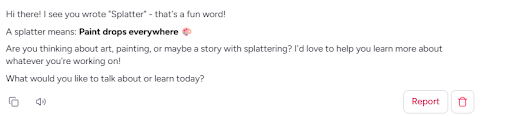
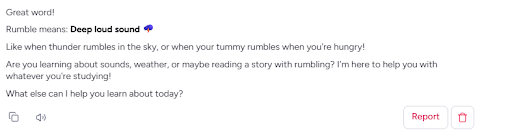
More examples of student work using the 3 Word Wonder tool
Final Thought: Designing for the Margins
When we design for the "margins"—for the Parkers who have big ideas but struggle to hold a pencil—we create a more accessible environment for everyone.
For too long, we have graded students’ writing on their ability to move a pencil rather than the quality of their thoughts. AI is the equalizer. It ensures that a student’s potential is no longer held hostage by physical hurdles. When we give a child a ramp, we aren't carrying them to the top—we’re just giving them the path to climb it themselves.
Photo at top by Allison Shelley/The Verbatim Agency for EDUimages, CC BY-NC 4.0
Kristen Liedtke
Educator, Coach, Mentor, Modern Classrooms Project
Kristen A. Liedtke, M. Ed., is an educator, coach, and mentor with a diverse background encompassing over fifteen years of experience in education, business, finance, and professional development. Kristen holds a bachelor’s degree in business administration, a master’s degree in education, and 24+ hours above while working on a degree in special education. She is skilled at evaluating student needs and creating individualized plans to facilitate success. Her capabilities include developing and implementing educational interventions, providing direct student support, and training staff. She is experienced in designing instructional materials through a systematic task analysis process to facilitate successful learning outcomes. Liedtke has also demonstrated strong leadership and organizational abilities, including mentoring and coaching educators and developing and implementing professional development activities. Her teaching experience is augmented by her background in business and finance, providing her with a unique perspective on the practical application of knowledge and the importance of effective communication. Follow Kristen on LinkedIn.