Your Favorite Learning Experience Charts the Way to a Learning Revolution for All of K-12

Andy Calkins
Co-Director
NGLC
in Gloucester, MA
Topics
Today’s learners face a rapidly changing world that demands far different skills than were needed in the past. We also know much more about how student learning actually happens and what supports high-quality learning experiences. Our collective future depends on how well young people prepare for the challenges and opportunities of 21st-century life.
We are all wise in ways that our education systems ignore. If we acted on what we know, we would see those systems as the barriers to powerful learning that they are.
Think about a particularly powerful, enduring learning experience you had, growing up.
No, really: take a moment to pause and do that. (I’ll do it, too.)
What learning experience occurred to you? Where and when did you encounter it? Why did you choose this particular experience?
More than likely, if you’re like the thousands of adults across the country that our non-profit organization and various school partners have put this question to in recent years, that experience was not to be found in your everyday schooling.
Very probably, you named an “extra” like your high school drama club, or the band, or a sport or a science fair project, or something that had no connection with attending school, unless it was to name a favorite teacher. My own choice is learning to play the cello—the instrument itself, and all of the disciplined practice that took, but also the many life lessons I learned playing in my high school orchestra and smaller chamber music ensembles.
I’m guessing that like me, you chose an experience that had deep meaning for you, that felt relevant to your future life, that gave you a sense of purpose and perhaps connection with a community. Looking back, you can see the kinds of life skills that experience helped you to develop.
Now, ask yourself this question.
What if your school—and the school your kids attend, the school every young person attends—were designed to spark that kind of powerful, purposeful, super-engaging, life-enhancing learning all the time? Every day?
Next Gen Learning Is Happening Right Now
Walk into Northern Cass School District in North Dakota and you’ll find third grade teacher Megan Margerum’s students creating their own “Watch Me Grow” projects—building on their natural, in-born curiosity to explore, make, communicate, learn, lead, and adapt. By eighth grade, students in Northern Cass complete more sophisticated, interdisciplinary “gateway projects” that help prepare them for high school’s demands. That’s where the learning twines with the world outside the classroom. An example: One music-interested senior recently rewrote (for credit) the final scene of Into the Wild as an original song, working with a professional musician in a recording studio to produce the track and her reflections on the experience.
These aren’t special programs for gifted students; they are what learning looks like for everyone at Northern Cass.
We know what powerful, whole-person, deeper learning feels like. But that kind of learning is not what our systems of schooling, testing, and accountability have been built to inspire.
This is Horizon 3 learning. What we at NGLC call next gen learning. These terms make this form of learning seem futuristic. But they reflect, in so many ways, what we already know as grown humans who’ve experienced many forms of learning in our lives.
We know what powerful, whole-person, deeper learning feels like. But that kind of learning is not what our systems of schooling, testing, and accountability have been built to inspire.
This future-sounding learning is not exclusive to the future; it is happening right now, for fortunate students and communities across the U.S. This learning is not the province of special schools on champagne budgets, enrolling selected or privileged students. It is happening now, in regular public schools working with diverse student populations on typical budgets, from rural North Dakota to urban Los Angeles and Portland, Maine.
For tens of thousands of lucky students in public schools like Northern Cass, the future is here, today. For them, experiences like the one you recalled as your most important, enduring journey of learning take place routinely. They are what school is all about.
For the 50 million other learners attending the nation’s public schools: not yet.
This isn’t a problem of knowing what to do or why to do it. It’s a problem of sparking and marshalling the will to help it happen.
It is the most urgent and important work of our time.
What “Next Gen Learning” Encompasses
All kinds of labels for powerful forms of learning have emerged over the past two decades: student-centered, project-based, blended, deeper, personalized, competency-based, experiential, real-world, authentic. These aren’t competing models. They’re overlapping approaches unified by what students actually experience: deep, enduring learning in which students find purpose and relevance; that is constantly informed by varied ways of demonstrating increasing competence and mastery; that is collaborative with teachers and peers; and is interactive, challenging, and equally accessible to every student. Students are the true protagonists.
“Next gen learning” is what happens when schools integrate these elements into coherent models—approaches that students experience as coherent—rather than treating the elements as add-ons to the pervasive, teacher-directed model that’s dominated what kids have encountered in U.S. public schools for a century now. It’s learning designed for both capability (knowledge and the skill to apply it in novel situations) and agency (the self-direction to take ownership of your own development and life choices). It’s the kind of learning today’s young people urgently need in order to thrive and contribute in a chaotic, rapidly changing world.
You don’t tend to hear “Will it be on the test?” from students in these schools. They understand that there are much better reasons to learn.
What Next Gen Learning Looks Like: Three Schools Showing the Way
Mission Vista High School (Vista, California) exemplifies learning redesign within complete school transformation. In other words: you can get there from here. You don’t have to have magical conditions such as the opportunity to start up a brand-new school.
Formerly a chronically underperforming school, Mission Vista operates today as a dual-magnet high school focusing on Arts & Communication and Science & Technology. Students create personalized four-year journeys through the school's curated pathway programs, enhanced through participation in Mission Vista’s 65+ clubs, student-produced TEDx events, and innovative senior capstone “My Vision Personalized” course. Principal Jeremy Walden describes how students “understand their individual strengths, interests, and values, and find ways to explore their individual passions” within flexible structures that allow for genuine choice.
What started as a pilot with just 11 students around a decade ago ended up transforming how the entire school operates, what its students experience, and how well they’ll navigate the world beyond graduation.
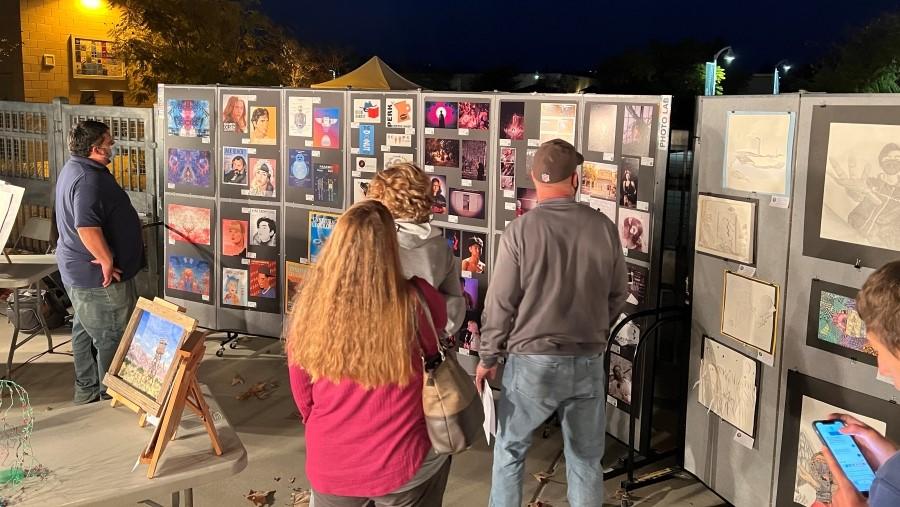
Student artwork on display at the Mission Vista High School Art Show. Credit: Will Salley, teacher, Mission Vista High School, Vista Unified School District
Casco Bay High School (Portland, Maine) beautifully demonstrates how relationship-building through “Crew” advisory programs and immersive, real-world learning motivates deep student engagement in their school.
At Casco Bay, Crew isn’t just homeroom; it’s where trust and belonging get built through deliberate structures that persist across students’ four years. Casco’s “learning expeditions” aren’t simply the occasional cross-curricular project you might find in traditional schools; they are Casco’s learning backbone, enabling students over time to take intellectual risks, engage in productive struggle, and develop the resilience required for deeper learning.
Students at Casco produce output and lead community projects with a level of poise, competence, and determination that regularly astonishes outsiders. As one 2020 graduate put it in her “Final Word” speech to her classmates: “In the end, Casco did not save me. But it did something so much better. It showed me how to save myself.”

Casco Bay High School students embark on an outdoor learning experience called Quest. Credit: Casco Bay High School
Sunnyside Unified School District (Tucson, Arizona) shows what district-wide coherence looks like through a relentless focus on Identity, Purpose, and Agency—their “IPA” vision for student success. Superintendent José Gastelum challenges visitors: “Everybody has one of these graduate profiles, right? Sometimes it's just a nice poster on your wall. But are you living it? Can students explain it? Can staff explain it?”
At Sunnyside, students don't just know the framework—they’ve internalized it. Desert View High School’s “Learning Ambassadors” lead fishbowl discussions with visiting educators about metacognition, feedback loops, and self-assessment. Students expertly distinguish between “true agency”—what Sunnyside cultivates—and the superficial “voice and choice” refrain of other, less visionary reform efforts. CTE (career and technical education) students proudly display the precision-designed and -produced prosthetic limbs they have created for amputees in Costa Rica and other countries.
Chief Academic Officer Pam Betten explains: “The kiddos might not name it as ‘coherence,’ but they sure experience it as coherence.” That's because coherence in Sunnyside isn’t a diagram; it’s a deeply shared depth of understanding about the purpose and nature of the work that is lived daily by students and adults alike.
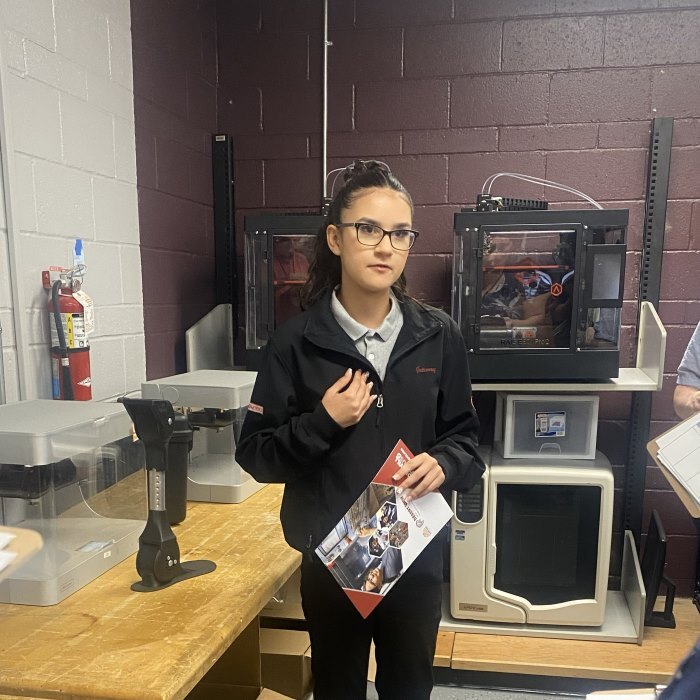
A Desert View High School student describes the prosthetic legs her schoolmates created and then fitted for patients. Credit: NGLC
What Makes These Examples Work
Three interconnected design principles enable these forms of learning.
1. Whole, Authentic, Purpose-filled Experiences
Traditional schooling fragments knowledge and skill development across curricular silos that don’t actually exist in real life. Next gen learning creates naturally integrated, developmentally appropriate “junior versions” of real work. (See this report from NGLC’s MyWays project for more on junior versions.)
If your own remembered learning experience involved an extracurricular activity, you’ve already landed on a perfect example. Your experience likely enabled you to learn in a variety of ways and contexts that felt real to you, sometimes on your own and sometimes collaborating with others, with a goal that made you actually want to work on the hard parts.
In next gen learning schools, that’s what happens every day. Students are developing a wide range of competencies by pursuing, either collaboratively or on their own, increasingly complex projects that provide a context of content. They vividly demonstrate the fallacy of tired, useless arguments about “knowledge vs. skills” or “hard vs. soft.” In the real world of these schools, educators lean into the science of learning and development, which clearly demonstrates the importance of integrating these goals and skills.
2. Personalized, Competency-Based Progression
These schools ask students to demonstrate increasing mastery of important skills in authentic ways, rather than accumulate seat time and take a series of narrowly-defined tests. They fluidly mix students instead of marching them through age-based grade levels. (Doesn’t every parent of two or more kids know how differently children learn, and at such different rates?)
Students understand the competencies they are working to develop—individually, for each learner—along with how and why they are developing them. The learners manage their own learning journey, in ways that match their ability to do so, an apprenticeship for managing their progress through college, career, technical skill-building, and civic and family life. They are literally practicing becoming adults by shouldering these responsibilities.
The schools’ shift from “I taught it” to “they learned it” fundamentally changes accountability and outcome mindsets across the entire school community. You don’t tend to hear “Will it be on the test?” from students in these schools. They understand that there are much better reasons to learn.
3. Breaking Down Unproductive Walls
For many students in traditional public schools, their real life lies outside their school’s walls. Inside the school, they generally can’t use the most powerful technologies humankind has created (smartphones and AI), they aren’t trusted to make important choices (when to go to the bathroom, among them), and they find much of what they’re learning boring and irrelevant.
In next gen learning schools, the line separating “inside” from “outside” is much more porous. In middle school and above, these schools integrate internships, community projects, dual-credit college course-taking, and sophisticated industry partnerships into daily schedules. Students build social capital—such an important life skill and resource—through relationships with mentors and employers while practicing competencies in real-world, adult contexts. This “Wider Learning Ecosystem,” encompassing everything from hospital alliances to community maker spaces, provides the complexity and authenticity that classroom-only learning cannot replicate.
The First Step: Urgency
Creating schools like these, or transforming existing schools to reflect these learning approaches, can be daunting, complex work. And yet: Today, thousands of students are learning this way and applying their youthful energy, curiosity and wide-open innovating to problems of literally every grain size, from campus litter issues to the U.N. Global Challenges. In doing so, they are acquiring the skills they’ll need—and that we all urgently need them to develop—in order to lead societal efforts to solve our biggest problems.
Meanwhile: tens of millions of other students are out there, hoping for the rest of us to act, and to welcome them as co-leaders of their own learning. Many of them are advocates for schools to change, helping to inspire advances that they themselves may not experience directly. Our public education system will not transform itself. But the people within it have the power to make it happen. It will take many of us, raising our voices and demanding that our community’s kids—that every community’s kids—grow up experiencing the learning that they deserve, and that the future of human life on Planet Earth urgently needs them to develop.
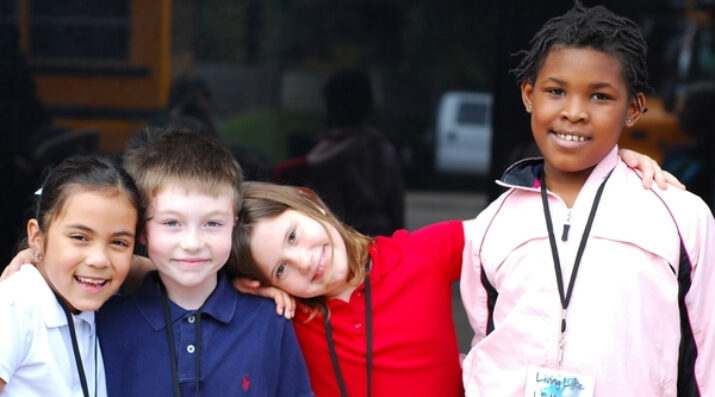
Photo at top courtesy of Montessori for All.
Andy Calkins
Co-Director, NGLC
As co-director for NGLC, Andy Calkins helps to lead strategy development, organizational management, and program execution across all phases of the initiative. Follow Andy on LinkedIn.