AI in the Classroom: Supporting Teachers without Replacing Humanity

Ryan Gravette
Director of Information and Technology
Idaho Digital Learning Alliance
in Nampa, Idaho
Topics

Educators increasingly rely on education technology tools as they shift instruction, redefine teacher roles, and design learning experiences that reflect how students actually learn. Technology should never lead the design of learning. But when used intentionally, it can personalize instruction, enrich learning environments, and help students master critical skills.
Guiding principles help teachers use AI as a powerful ally in reducing stress, sparking creativity, and personalizing learning, without losing the essential and central teacher-student relationship.
When we talk about AI in education, the focus often lands on students. But an equally important question is: what does AI mean for teachers?
As educators face mounting workloads, rising expectations, and the ongoing challenge of meeting diverse student needs, AI promises relief. But it also raises concerns. Can AI truly support teachers, or will it risk replacing some of what makes teaching uniquely human?
Three Ways Teachers Are Using AI
From my conversations with educators, I’ve seen AI adoption fall into three categories:
Informing: Teachers utilize AI to facilitate understanding and create personalized emails, translate communications, or summarize student data. This saves time without altering the core of teaching.
Augmenting: AI co-creates resources, such as quizzes, rubrics, and lesson outlines, that teachers then refine. The materials are often replacing traditional textbooks with more interactive experiences. Here, AI acts as a creative assistant.
Replacing: Some teachers experiment with AI for grading or even generating feedback without reflection. While efficient, this raises deeper questions about whether critical aspects of teaching should ever be outsourced.
The Promise of AI for Educators
There’s no denying the promise. Teachers often spend hours on administrative tasks that take them away from what matters most: building relationships with students. If AI can reduce paperwork and streamline preparation, it frees educators to focus on mentoring, guiding, and inspiring.
AI can also spark creativity. A teacher designing a lesson on climate change might ask AI to generate scenarios or discussion prompts, then adapt them to their class’s context. Instead of starting from scratch, they start from a place of possibility.
The Risks We Must Avoid
But the risks are real. If schools lean too heavily on replacement and fail to maintain the human connection, we risk eroding the relational core of teaching. Feedback is not just about correctness. It’s about encouragement, care, and the subtle cues that show a student their effort is seen and valued. A machine cannot replicate that.
There’s also the danger of over-reliance. If teachers come to depend on AI for every lesson or assessment, their professional judgment and creativity may erode. AI should enhance expertise, not diminish it. AI should empower our quirky selves, not homogenize us by abdicating to an AI voice that produces normalized outputs. Humanity resides in the tails of data, not in the average.
Striking the Balance
So how do we strike the balance? A few guiding principles help:
Efficiency, Not Substitution: Use AI to reduce busywork, not to replace human presence or connection.
Transparency: Let students know when AI is used or not used for the particular assignment and why the decision was made. Model responsible and ethical use.
Professional Development: Provide training so teachers feel empowered, not threatened, by AI tools.
Connection: Always ask: Does this strengthen or weaken the teacher-student relationship?
The future of teaching is not human versus machine; it’s human with machine. AI can be a powerful ally in reducing stress, sparking creativity, and enabling personalization. But we must hold firm to a guiding principle: education is a human endeavor.
No algorithm can replace the spark in a student’s eye when they feel understood, the encouragement of a teacher who believes in them, or the care that motivates persistence. As we integrate AI, let’s ensure it enhances these moments rather than erases them.
The heart of teaching is irreplaceable. AI should remind us of that truth, not challenge it.
Listen
🎧 Hear more in my full EDU Café conversation!
More from the Author
The Future of Work in the Age of AI: Inform, Augment, Replace - AI’s role in reshaping the way we work can be characterized by three stages—inform, augment, and replace—impacting the student success skills that matter most.
Students as AI Natives: Rethinking Learning for the Next Generation - AI that replaces learning undermines the very purpose of education. But when AI informs and augments learning, it enables deeper engagement and more analysis, critical thinking, and creativity.
NGLC is grateful for our collaboration and partnership with EDU Café Podcast that brings fresh voices and insights to the blog.
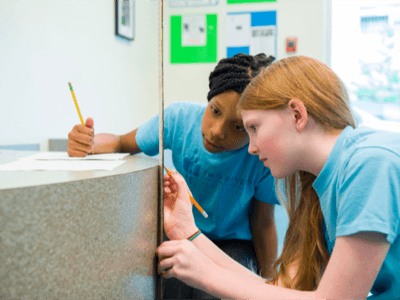
Photo at top by Allison Shelley for EDUimages, CC BY-NC 4.0.
Ryan Gravette
Director of Information and Technology, Idaho Digital Learning Alliance
For 20 years, Ryan Gravette has focused on using edtech to tear down the barriers to great teaching and learning. He is the technology director for IDLA and holds an MBA, a BS in psychology, and certifications in CISSP, AWS Architect, CCNA, and Six Sigma. Follow Ryan on LinkedIn.