Boosting Collaboration with Vertical Whiteboard Activities in Modern Classrooms

Christina Herrick
Language Arts Teacher
Ellington Middle School
in Ellington, Connecticut
Topics
We’ve all had the experience of truly purposeful, authentic learning and know how valuable it is. Educators are taking the best of what we know about learning, student support, effective instruction, and interpersonal skill-building to completely reimagine schools so that students experience that kind of purposeful learning all day, every day.
Introducing Building Thinking Classrooms strategies into personalized learning models can increase student collaboration and engagement in deeper learning.
When I learned about the Modern Classrooms Project (MCP) in 2020, my classroom transformed. I replaced mini lessons with instructional videos that I created, freeing me to spend time engaging directly with students, rather than managing whole class behaviors. Students were learning at their own pace. That student who went away on vacation? Pre-recorded lessons had them covered. That student who flew through classwork? They could challenge themselves with Aspire To Do content. Mastery of standards was the goal and I was their coach. It was incredible.
The Problem: Too Much Independent Learning, Not Enough Peer Collaboration
Over the course of a semester, I noticed that students were consistently choosing to work independently rather than collaborating. When students did work together, it was less collaborative learning and more parallel work. Students watched an instructional video using headphone splitters and took notes. Students divided up who would complete tasks and then shared out the answers. These behaviors weren’t bad, but research shows that collaborative work improves academic and social skills. I noticed COVID-19 had weakened students' conversational skills and I wondered if this had something to do with students’ choices to work independently as well. Collaboration is an essential life skill. I wondered, was my use of self-paced, mastery-based learning limiting communication and social development in my classroom? Do students lack collaboration skills, or do they simply prefer solitary work?
Building Thinking Classrooms Meets MCP
At the time, my administration and math department were diving into the book, Building Thinking Classrooms in Mathematics, Grades K-12: 14 Teaching Practices for Enhancing Learning (2021). The Building Thinking Classrooms (BTC) approach is gaining momentum. The approach developed by Dr. Peter Liljedahl, professor of mathematics education at Simon Fraser University in Canada, is profoundly impacting math classrooms around the country and creating a buzz with educators looking to implement its practices across other disciplines. Peter observed teachers struggling to engage students in deeper thinking and learning and his work answers the question: How can we get students to think and to think longer?
I started doing my own investigation and learned that many teachers had already been using these strategies in language arts classes. There were Facebook groups with teachers sharing ideas freely with the goal of helping engage students in deeper thinking. I used this work as an opportunity to explore my own challenges with collaboration. Maybe providing students with deeper thinking tasks would promote collaboration.
Introducing Vertical Whiteboards
I decided to try out one of Peter’s strategies, vertical whiteboards, because his research linked vertical work to better moods and higher energy levels. If you’ve ever taught middle schoolers, you know that this is always an area for improvement. He also cites in his research that standing improves communication and learning amongst students. Students can’t “check out” as much when they are visible at their boards posted around the room. Instead, students exchange ideas and wonder aloud together. Teamwork and shared problem-solving are the goals.
This seemed like a great way to strategically introduce collaboration with my students. I set out to blend BTC ideas into my Modern Classroom Project classroom. I borrowed Wipebook Flipcharts and introduced vertical whiteboard Do Nows three times a week.
The Logistics: Encouraging Collaboration and Thinking Vertically
As students entered the room, I greeted them with a card that assigned them to a different table, helping them collaborate with peers they wouldn’t usually sit near. I used UNO cards—easy and no-prep. Students dropped their belongings and headed to the whiteboard matching their table number. On the Smartboard, I projected their task and groups had five minutes to complete it.
When using vertical whiteboards, there are a particular set of rules. Keeping these posted and referring back to them regularly was extremely helpful.
Groups are randomized; typically 2–3 students per group. I found that 3 was the sweet spot.
Only one student writes at a time; others contribute verbally. Teachers occasionally facilitate a change of writer.
Students remain standing and must stay with their group. This wasn’t always easy.
Students may look at other boards but not copy; they also cannot erase others’ work.
Over the course of the year, I tried several different Do Nows on vertical surfaces. I started simple with ice breakers such as “soup, salad, sandwich” in order to reinforce vertical whiteboard norms. As time went on we re-wrote paragraphs in groups, constructed written responses, and analyzed characters using webs. We made Frayer Models and identified central ideas together. We even replaced writing tasks with collaborative activities when piloting Amplify curriculum resources. As long as the tasks were open-ended, they were vertical whiteboard worthy.
Reflection and Advice
What did I learn about whether students lack collaboration skills or prefer solitary work?
I observed that students are noticeably more engaged and collaborative. Students reflect that this approach is more fun and breaks up the monotony of self-paced work.
Relationships are deepening—students are interacting more with peers. I’ve even developed more meaningful relationships with my students. I’ve seen an increase in collaboration during self-paced work as well.
MCP includes frequent reflection on whether students feel cared for by their teacher. Survey responses on this question improved when I incorporated Building Thinking Classrooms strategies.
Whether you implement blended, self-paced, mastery-based practices or not, vertical whiteboard work has the potential to increase collaboration and critical thinking in your classroom. Don’t be discouraged if you don’t have whiteboards—use chart paper, construction paper, you name it! It doesn’t need to be pretty. Remember, just like adults who are collaborating together, some groups will be less productive than others with random grouping. Use it as an opportunity to chat with groups about effective collaboration. Instead, enter it with curiosity and not as evaluative! It’s easy to feel overwhelmed; we all have lots on our plates. Connecting with other teachers around the country who are trying to implement these ideas for support and ideas is invaluable. Vertical whiteboard work alongside self-paced, mastery-based instruction has transformed my classroom—try it out to see your students collaborate as they engage in deeper learning!
References
Gillies, R. M. (2016). Cooperative learning: Review of research and practice. Australian Journal of Teacher Education, 41(3). Retrieved from https://ro.ecu.edu.au/cgi/viewcontent.cgi?article=2902&context=ajte
Theobald, E.J., Eddy, S.L., Grunspan, D.Z., Wiggins, B.L., & Crowe, A.J. (2017). Student perception of group dynamics predicts individual performance: Comfort and equity matter. PLOS One, 12(7): e0181336. https://doi.org/10.1371/journal.pone.0181336
Gonzalez, J. (2020, February 4). Making cooperative learning work better. Cult of Pedagogy. https://www.cultofpedagogy.com/making-cooperative-learning-work-better/
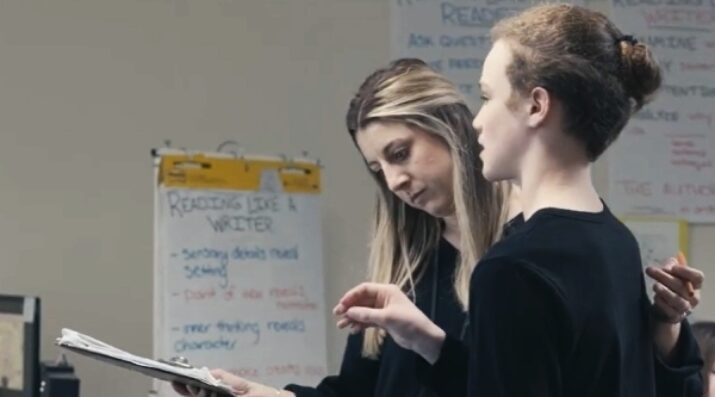
Image at top of the author with a student is a screenshot from the video "Modern Classrooms in Connecticut." Courtesy of Modern Classrooms Project.
Christina Herrick
Language Arts Teacher, Ellington Middle School
Christina Herrick is a language arts teacher at Ellington Middle School in Ellington, Connecticut, passionate about designing curriculum and implementing instructional technology to support self-paced, blended, and mastery-based learning. She mentors and coaches educators nationwide to design classrooms and learning experiences that meet the needs of all students. Her work centers on helping teachers rethink traditional approaches to education through personalized, student-centered instruction.