How to Encourage Student Mathematical Confidence through Exploration

Elena Maren
Writer and Montessori Guide
Alphabet Trains
Topics
We’ve all had the experience of truly purposeful, authentic learning and know how valuable it is. Educators are taking the best of what we know about learning, student support, effective instruction, and interpersonal skill-building to completely reimagine schools so that students experience that kind of purposeful learning all day, every day.
Research shows that when students experience math as exploration rather than performance, their confidence, curiosity, and long-term mathematical thinking all grow.
When Math Feels Like a Performance Rather than Discovery
Students may become disconnected from exploring mathematics due to the number of times that they experience math as a performance (i.e., "I'm supposed to get this right") rather than discovery. Some will develop a dislike for it when they draw attention to themselves in a classroom setting after answering a question wrong. Eventually as time progresses, students that initially viewed numbers with a sense of curiosity and wonder about what could be discovered may eventually view mathematics as a source of stress or pressure, or a source of fear related to the possibility of failure.
For decades, researchers and educators have sought to determine the nature of the relationship between the emotional experiences that occur during the process of learning mathematics and the process of developing mathematical knowledge. The last decade has seen a growth in the amount of mathematics education research that indicates that confidence, classroom climate, curiosity, and opportunities for exploration all contribute significantly to how students come to develop their own mathematical knowledge over time.
The American Psychological Association (APA), for example, reported how students' emotional responses to mathematics can impact the way that they learn math in the future. APA's research suggested that merely anticipating a math assignment can elicit a stress response in some students, which can negatively affect working memory and problem solving. Researchers writing in Frontiers in Psychology documented similar results regarding students that exhibit math anxiety; these students are less capable of performing at their potential levels due to excessive use of cognitive resources to manage the anxiety/stress versus using those same cognitive resources to solve problems.
When students continually experience mathematics as either stressful or embarrassing, they typically begin to avoid mathematical situations. Multiple studies investigating interventions for math anxiety identified this as a type of reinforcing cycle: increased fear produces increased avoidance, increased avoidance limits opportunities for improvement, and decreased confidence increases anxiety further.
Students are much more likely to develop flexible reasoning and continued confidence in their ability to think mathematically when math also includes the opportunity for experimentation, reflection, collaboration, and conceptual exploration.
This cycle does not imply that fluency and practice do not continue to provide value. They certainly do. Automaticity from repeated practice provides a foundation for higher level thinking in mathematics. Many researchers now believe, however, that students are much more likely to develop flexible reasoning and continued confidence in their ability to think mathematically when math also includes the opportunity for experimentation, reflection, collaboration, and conceptual exploration.
How Learning Mathematics through Exploration Supports Students
The idea of providing students with experiential/inquiry-based approaches to learning mathematics is by no means a novel concept. While educational theorists such as John Dewey, Jean Piaget, Lev Vygotsky, and David Kolb developed distinct theoretical perspectives on how students construct knowledge through experientially-based activities, they all agreed that when students take an active role in constructing knowledge, the resulting knowledge is generally more meaningful, enduring, and deeper.
Kolb's Experiential Learning Framework, which is commonly cited within modern research on teaching mathematics education, says learning is best understood as a cycle involving concrete experience, reflective observation, abstract conceptualization, and active experimentation. Within a mathematics classroom environment, this often means that students are engaged in procedural problem solving and physical, visual, verbal, and collaborative interactions with mathematical ideas.
The sum of the research suggests that students who participate in hands-on, collaborative, and authentic learning environments demonstrate improvements in their attitudes toward mathematics, their participation rates, self-efficacy beliefs, degree of engagement, flexibility in applying mathematical concepts, and persistence through challenging tasks.
For example, prior to formal introduction to geometric concepts, students may estimate and compare various quantities. Students may discuss geometric concepts by measuring classroom objects. Students may test out several approaches to solve a problem. Students may create visual representations of mathematical concepts using manipulative objects. Students may articulate their reasoning aloud with peers before presenting a solution.
Increasing amounts of research on experientially engaging with mathematics supports the notion that students are able to build stronger connections among conceptual ideas in mathematics when they experience the ideas as interactive and meaningful and related to real-life experiences. Early childhood settings offer students numerous opportunities for building confidence and curiosity when they experience numbers, patterns, and measurements through hands-on math experiences rather than experiencing them through fear or performance pressures.
In a large quasi-experimental study examining active-experiential mathematics instruction, researchers Amalija Žakelj, Mara Cotič, and Daniel Doz found that eighth-grade students enrolled in classes employing more active learning experiences were able to demonstrate stronger conceptual understanding and improve their performance on both simple and complex mathematical problem-solving tasks relative to students who received more traditional transmission-based instruction. Other experientially-focused studies on mathematics education reported similar findings; the sum of the research suggests that students who participate in hands-on, collaborative, and authentic learning environments demonstrate improvements in their attitudes toward mathematics, their participation rates, self-efficacy beliefs, degree of engagement, flexibility in applying mathematical concepts, and persistence through challenging tasks.
While exploratory mathematics is often portrayed as replacing structured lessons with recreational activities, successful experiential-based classrooms are well-structured learning environments. They provide support to students as they actively explore relationships among mathematical concepts rather than simply memorizing separate procedures without comprehension of the underlying mathematical principles connecting them.
Concrete Experiences Supporting Abstract Conceptual Understanding
Studies examining the effects of experiential learning on student understanding have consistently shown that conceptual understanding is strengthened when students explore ideas through movement, visual models, collaborative discussion, hands-on experimentation, and concrete materials. Younger students tend to build more effective foundations for their future understanding of mathematical ideas when they can observe and explore concrete examples of mathematical concepts before transitioning into symbolic representations.
When students develop their own understanding of math through exploration, application, and reflection rather than through rote memorization, they tend to remember their math ideas better.
Many Montessori-inspired mathematics environments allow children to progress from concrete learning to abstract learning. Within these environments, children learn math by working with tactile materials, such as wooden toys that represent quantities, place values, operations, fractions, etc. Montessori researcher Angeline Lillard and other scholars researching child development note that Montessori classrooms incorporate a lot of hands-on learning, self-directed discovery, and developing conceptual understanding. A 5-year longitudinal study was conducted by Dr. Lillard and her colleagues. That study showed that students who learned in Montessori-style learning environments had better problem-solving skills in math than their peers in typical educational systems. Furthermore, the difference was most apparent in students' ability to think conceptually about problems rather than their ability to solve problems faster. Therefore, providing students with opportunities to explore math problems appears to promote long-term reasoning processes.
Additionally, many of the same researchers have indicated that although procedural knowledge is necessary for long-term problem solving, students will typically forget the procedure unless they understand the concepts connecting those procedures. When students develop their own understanding of math through exploration, application, and reflection rather than through rote memorization, they tend to remember their math ideas better. While students will always need opportunities to practice and develop fluency with procedures, many educators argue that procedural fluency becomes far less meaningful when students don’t understand the relationships between procedures and mathematical concepts.
Mistakes Are Important When Learning Math
Another significant area of research on building student confidence in math concerns mistakes and how mistakes relate to learning. In many classrooms, students see errors as proof that they failed at something. This can lead to decreased confidence in mathematics where quickness and accuracy are often praised. However, educational psychologists Gabriele Steuer, Maria Tulis, and Elizabeth R. Peterson argue that students must feel comfortable making mistakes in order to truly learn and think productively. They indicate further that if students never make mistakes during the learning process, then there is reason to question whether or not true learning is taking place. Additionally, they found that students use different strategies for working through difficult assignments when they are not afraid of making mistakes and when they are encouraged to reflect on their mistakes, revise their thinking, and collaborate with others. In those types of learning environments, students tend to continue working through challenging assignments longer because mistakes are seen as a normal part of the learning process rather than as indicators of incompetence.
However, as previously stated, producing meaningful learning through mistakes is not automatic. Students require guidance, feedback, and opportunities to reflect on their misconceptions in a constructive manner. For example, having a class discussion where multiple ways to find solutions to a problem are encouraged before finding a final solution creates a completely new way for students to perceive their own thinking and relationship-building between mathematical concepts. Students begin to focus on understanding how their ideas are connected as opposed to being embarrassed by incorrect answers.
Collaboration in problem-solving activities, visual representations, and open-ended reasoning tasks provide students with natural opportunities to produce this type of thinking as students can compare each other's ideas and methods for solving problems without every exchange needing to be evaluative.
Building on these same research findings regarding "psychologically safe" classrooms, researchers have identified that students tend to persist longer through challenging work when learning environments minimize the perceived psychological threat of failure. Similar patterns exist in both research regarding math anxiety and research on self-efficacy where supportive classroom environments were consistently correlated with higher levels of student persistence and engagement.
Exploration vs. Fluency
Researchers have determined that successful mathematics instruction does not necessarily involve a trade-off between exploration and fluency. Research, like Rickard Östergren and colleagues’ study of 877 second grade students, has shown that repeated practice and retrieval of procedures can help reduce students’ cognitive load during more complex problem-solving situations. This creates more space for students to focus on reasoning processes, not just computational processes, when solving complex problems.
Many studies in the field of conceptual mathematics suggest that fluency and conceptual understanding are often most effective when developed together rather than separately. Students who are able to see the relationships in a subject area conceptually are generally able to use procedures appropriately in unfamiliar contexts. Fluency development provides students with a sense of security as they develop the ability to perform foundational calculations easily and efficiently.
Many classrooms today are finding ways to integrate structured fluency practices into collaborative exploration and conceptual discussions; students often explore concepts and test ideas in groups, develop fluency through repetitive practices (e.g., exercises), and then find ways to apply their skills in a variety of situations. Well-planned learning environments typically allow both types of learning to occur in conjunction with each other.
Long Term Development of Student Self-Efficacy
Bandura's theory of self-efficacy explains why mastery experiences are such an important part of the learning process. When students are challenged, supported sufficiently to complete the task(s) presented, and believe that they can successfully tackle the challenges in front of them, confidence develops. The cumulative effect over time of experiences that promote conceptual understanding, exploration, collaboration, and productive struggle is that students develop a greater belief in their own abilities as mathematicians.
Students who view themselves as competent mathematicians tend to take risks when encountering unknowns, persist after mistakes, pose open-ended questions regarding problem-solving processes, and continue to participate when tasks become challenging. This is one reason why providing low-stakes exploratory mathematics experiences during early childhood and elementary school years is particularly relevant. Such environments give students opportunities to experience mathematics as something exploratory rather than intimidating.
When children explore number sequences using manipulatives, estimate distances outdoors, measure ingredients used in cooking activities, discuss various methods of solving problems with peers, etc., they are demonstrating rigorous mathematical thinking. Many times, this type of understanding is enhanced by having students construct their own meaning as opposed to merely applying mechanical procedures.
Researchers studying experiential mathematics education consistently found significant improvement in student performance outcomes, student participation, mathematical communication, self-efficacy beliefs, and motivation to take on more challenging problems. The collective results of numerous studies demonstrate that when students experience mathematics as exploratory, collaborative, and connected to real-world applications/meaningful experiences, they are more likely to be engaged and persistent than if the focus is solely on speed or memorization.
As a result, more educators have started paying closer attention to how students experience mathematics rather than focusing only on what students are expected to learn. Confidence, curiosity, reflection, and conceptual understanding are increasingly recognized as important parts of high-quality mathematics instruction rather than distractions from it.
Ultimately, the experiences students have in their classrooms will contribute significantly to whether they perceive mathematics as something that they would prefer to avoid or something they have the confidence to explore—to comprehend, make mistakes, and continue to develop their mathematical reasoning and problem-solving skills.
Resources Cited
- American Psychological Association. “Helping Kids Manage Math Anxiety.”
- Carey, Emma et al. “The Chicken or the Egg? The Direction of the Relationship Between Mathematics Anxiety and Mathematics Performance.” Frontiers in Psychology.
- Žakelj, Amalija, Mara Cotič, and Daniel Doz. “Evaluating the Impact of Active and Experiential Learning in Mathematics: An Experimental Study on Eighth-Grade Student Outcomes.” Cogent Education.
- Lillard, Angeline S. et al. “Montessori Preschool Elevates and Equalizes Child Outcomes: A Longitudinal Study.” Frontiers in Psychology.
- Steuer, Gabriele, Maria Tulis, and Elizabeth R. Peterson. “Learning from Errors and Failure in Educational Contexts.” British Journal of Educational Psychology.
- Östergren, Rickard, Ulf Träff, Jessica Elofsson, Hugo Hesser, and Joakim Samuelsson. “Memorization versus conceptual practice with number combinations: their effects on second graders with different types of mathematical learning difficulties.” Scandinavian Journal of Educational Research.
- Street, Karin Elisabeth Sørlie, Lars-Erik Malmberg, and Stanislaw Schukajlow. “Students' Mathematics Self-Efficacy: A Scoping Review.” ZDM Mathematics Education.
- Kolb, Alice Y., and David A. Kolb. "Learning Styles and Learning Spaces: Enhancing Experiential Learning in Higher Education." Academy of Management Learning & Education.
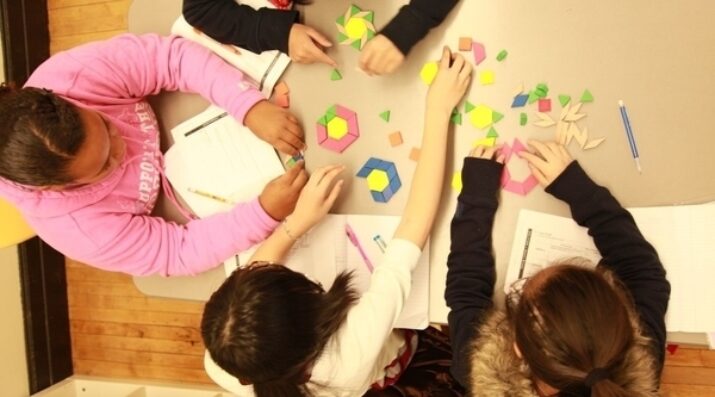
Photo at top courtesy of New Classrooms.
Elena Maren
Writer and Montessori Guide, Alphabet Trains
Elena Maren is a writer and Montessori guide who writes extensively on the subject of child development through prepared environments. Through Elena's experience in educational psychology and working in international Montessori communities, she offers readers a delicate combination of guidance and practical advice to assist modern parents and educators in fostering emotional and intellectual growth in children.