Human First, AI Forward: Why Discussion Is the Skill That Changes Everything

Liza Garonzik, Founder, CEO, and Author; and Nora Landon, English Teacher and Department Chair
Topics
We’ve all had the experience of truly purposeful, authentic learning and know how valuable it is. Educators are taking the best of what we know about learning, student support, effective instruction, and interpersonal skill-building to completely reimagine schools so that students experience that kind of purposeful learning all day, every day.
From artificial intelligence to authentic interaction, AI is shaping the humanities and the role that discussion plays in learning.
At a moment when artificial intelligence is rapidly reshaping education, it’s easy to focus on what’s new, what’s disruptive, and what’s uncertain. But in schools across the country, a different question is emerging, one that feels both urgent and enduring: What matters more, not less, about being human?
As educators grounded in the humanities, we’ve spent the past year exploring this question alongside a cohort of thoughtful teachers and leaders. What we’ve found is both simple and profound:
The future of education isn’t just about preparing students to use AI.
It’s about preparing them to be deeply, thoughtfully human.
The Conversation Crisis in Our Classrooms
In many classrooms today, there are subtle signs that students are struggling with their humanity! Take class discussion, for example. Discussion is a uniquely human skill and a definitively human experience. And yet, we see that students are:
Less comfortable sitting in intellectual discomfort.
More hesitant to disagree with one another.
Increasingly prone to conversations that mirror social media—affirming, but not probing.
We sometimes call this the rise of “affirmation culture,” in which ideas are acknowledged with emoji reactions or +1s but not advanced or challenged. Where conversation feels more like a series of likes than a genuine exchange.
But the issue isn’t that students can’t communicate. It’s that they haven’t been explicitly taught how. And they like opportunities to practice.
Discussion Is Not a Talent; It’s a Skill
One of the most transformative realizations in our work has been this: Discussion is not innate. It is teachable.
When we intentionally teach students how to listen actively, disagree with respect, build on others’ ideas, and ask meaningful questions, we unlock far more than academic outcomes.
We begin to see:
Increased confidence, especially in quieter students;
Stronger relationships and deeper peer connection;
Greater willingness to engage in complex, nuanced thinking; and
The emergence of what we call gracious conflict.
And perhaps most importantly, students begin to understand that you can disagree with someone’s idea without rejecting the entire person (as one student explained).
The Humanities as a Human Skills Lab
In the rush to adapt to AI, many schools have focused on tools, policies, and guardrails. These are important.
But what often gets skipped is the deeper question: What is the purpose of education in an AI era?
Our answer is clear: Humanities classrooms must become intentional spaces for cultivating humanity.
This doesn’t mean rejecting AI. In fact, we believe strongly in being AI-forward.
But it does mean being pro-human, pro-teacher, and grounded in purpose.
Reading, writing, and discussion are not just academic exercises. They are the foundation of ethical thinking, empathy, perspective-taking, and civic engagement. In other words, they are how we prepare students not just to succeed but to contribute meaningfully to the world.
The “Other AI”—Authentic Interaction
There’s a phrase we’ve come back to again and again in this work: the other AI, which is Authentic Interaction.
If artificial intelligence is transforming how we access and generate information, then authentic interaction is what ensures that information becomes meaningful, relational, and human. And yet, authentic interaction doesn’t just happen. It must be modeled, practiced, structured, and valued.
When we do this well, discussion becomes more than a classroom strategy. It becomes a catalytic skill set and one that transfers into leadership roles, team dynamics, conflict resolution, and community engagement.
A Manifesto for This Moment
Out of our work with educators across the country, we developed the Humanity & Humanities in an AI World Educator Manifesto. This document is not anti-AI; rather, it is a declaration of values. It affirms that human skills are foundational, not optional; the role of educators is more essential than ever; and schools must move forward with both innovation and intention. For many educators, the manifesto has served as both a counterbalance to rapid technological adoption and an anchor for decision making around curriculum and instruction.
What Gives Us Hope
Despite the challenges and the very real questions, there is reason for optimism. It’s one reason we talk about the Conversation Crisis, but more importantly, the Conversation Comeback that teachers can lead in their classrooms and leaders can support across campuses.
We see it in:
Students who are eager to connect, even if they need guidance on how.
Educators who are deeply committed to this work.
Communities that recognize that human skills are not expendable.
The future of education will undoubtedly include AI in ways we are only beginning to understand. But one thing feels certain:
We cannot build thoughtful, ethical AI users or creators without first cultivating thoughtful, ethical humans.
And that work begins in our classrooms, in our conversations, and in our commitment to teaching what matters most.
Listen
NGLC is grateful for our collaboration and partnership with EDU Café Podcast that brings fresh voices and insights to the blog. Listen to the full episode of the podcast that inspired this article.
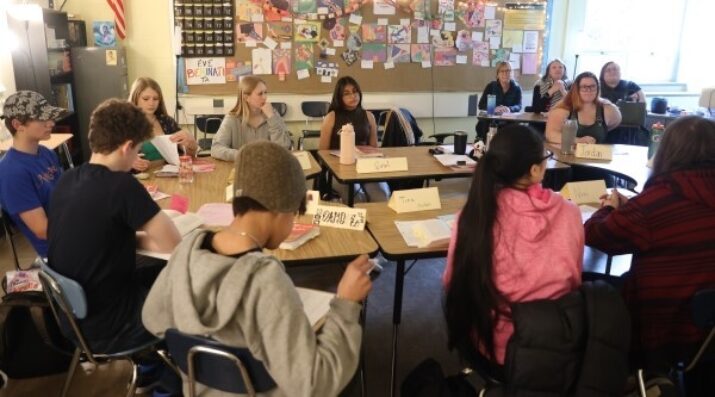
Photo at top, of a class discussion at Harwood High School in Vermont, by Brian Ambrose for NGLC (now LEAP Innovations)
Liza Garonzik, Founder, CEO, and Author; and Nora Landon, English Teacher and Department Chair
Liza Garonzik is founder and CEO of R.E.A.L.® Discussion and the author of Conversation Comeback: A Teacher’s Guide to Class Discussion in a Distracted, Divided World and Conversation Comeback: A Schoolwide Guide to Discussion in a Distracted, Divided World. Follow Liza on LinkedIn.
Nora Landon is an English teacher and department chair at William Penn Charter School, a pre-K to 12 Friends school in Philadelphia. Follow Nora on LinkedIn.