How to Organize for Human Development: What Schools Can Learn from Summer Camps
Jal Mehta (he, him, his)
Professor of Education, Harvard Graduate School of Education,
Co-Director, Deeper Learning Dozen
Topics
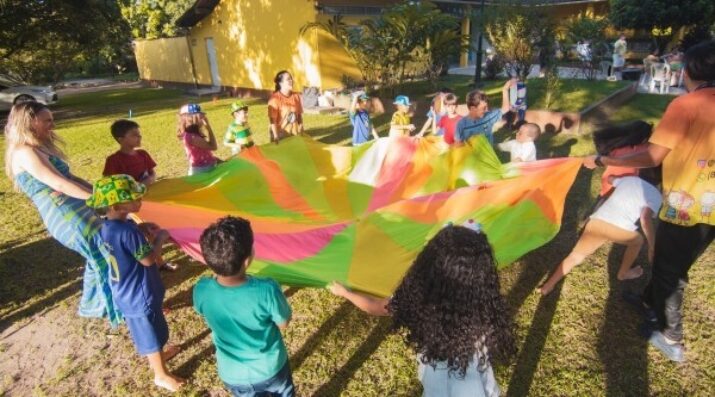
We’ve all had the experience of truly purposeful, authentic learning and know how valuable it is. Educators are taking the best of what we know about learning, student support, effective instruction, and interpersonal skill-building to completely reimagine schools so that students experience that kind of purposeful learning all day, every day.
A week at family camp turned into an unexpected lesson in school design—and seven principles might help us reinvent school for the better.
It wasn’t my idea. But it turned out that I didn’t know what I was missing.
This past week my family—five of us—voluntarily settled ourselves in a one room cabin for a week of camp. We had been recruited by my sister-in-law’s family—six in all—for a week of s’mores, Family Feud, talent shows, archery, lakefront swimming, and lots and lots of climbing.
And so it was, that on a Wednesday morning, rather than sitting in my usual coffee shop poring through the pages of Dewey or Arendt, I found myself stuck on a rope net, 30 feet in the air, arms straining, feet slipping, wondering if this was how it was all going to end.
Spoiler alert: I’m fine. And perhaps better than fine—I’m finally starting to see why camp is so special to so many.
As I thought about what I was experiencing, I came to see that the way camps are organized holds a promising alternative to what we see in public schools. There wasn’t less structure. There was a different kind of structure. One that was intended less to sort, standardize, and compel, and more to empower, discover, and grow. Dewey and Arendt would have been impressed.
So, how did it work? Kids were invited to join a kids club, organized by age bands. The littlest ones were the hummingbirds (my niece Anna was a particularly cute hummingbird), the 5 and 6 year olds were the chipmunks, 7 to 9 were the turtles, 10 and 11 were the foxes, 12 and 13 the eagles, and 14 and up the wolves. For each day, we were given two pieces of paper the night before: a schedule of the kids’ activities for the next day (organized by time and age group) and a schedule of family activities, with a few activities that were bolded as adult only. So, if you were a kid, you could spend the whole day with your family, you could spend the whole day in kids club, or you could dip in and out of both depending on the activities offered. For the adults, you similarly might dip in and out of various configurations—I played beer softball with the adults, I went ziplining with my wife and our older two boys, I played on the lake inflatables with my oldest and my youngest.
Meals were mostly together and they were festive. Music was always playing, and a man who introduced himself as Blutto was our MC for the week. Over meals we played lots of silly games and contests: a new friend from softball and I won a watermelon eating contest (no hands!) against another pair of dads; our 11-person family tribe eked out a win in Family Feud when another family couldn’t come up with the fifth most popular pizza topping (onions?!); and a woman who identified herself only as “princess” won a come from behind victory by gradually working an Oreo cookie down from her forehead, off her cheekbones, and into her mouth. The week ended with a talent show, where Anna enthusiastically danced to “Baby Shark” and was dubbed a future star by Blutto, tween girls hula hooped at varying levels of skill, and a 10 year old boy stole the show dancing à la Michael Jackson to “Billie Jean.”
The staff and counselors were unfailingly polite and positive. “Would you like an empanada?” one asked at a designated snack break. “Or two? Or three?” I took two, which she dubbed “amazing” in her proper British accent. Large contingents of the staff hailed from the U.K. and Australia and smaller groups came from South America and India, adding an international vibe to this Connecticut-based camp with primarily U.S. campers. Blutto was like a Durkheimian totem—always there, always wearing a different outfit as he assumed a different character, giving all 150 of us a common experience.
Ok, so what was happening here that might be of interest to sociologists or would-be improvers of public schools? Schools are not camps—they have different missions. But some lessons still might be useful. I will highlight seven.
1. A Different Organizational Grammar
This is the most fundamental choice. Camps seem to have figured out something that schools are still struggling with: How to build an organizational grammar that has enough structure to organize a large group of people into productive activities while still creating space for considerable initiative, choice, growth, and emergence. They did this by building a big schedule, assigning someone to each activity, but then giving everyone lots of choice about which activities they took up. Rather than the “go here, then go there” ethos of schools, which leaves kids in a very passive posture, everyone got the full schedule and then decided where to go. The activities themselves also had a nice blend of structure and emergence—there is going to be a talent show, and your group needs to have something ready for it, but what you choose to exhibit is up to you.
2. Human Scale
Camps split kids into relatively small groups, usually 8-12, with a counselor. In a traditional overnight camp that counselor might live with the kids; in this camp they went with them to all of their activities. At this scale, and proximity, counselors build deep human connections with kids, getting to know them as individuals, recognizing their strengths, and helping them grow over time. There are lots of ways we could realize a similar goal in public schools—splitting larger schools into smaller academies, having teachers loop with students, using advisories as places that build connection and purpose. But we need to keep “human scale” in mind as a critical design principle in whatever we build.
3. Many Ways to Matter
I’m increasingly coming to view schools as monocultures: there is one way to be, one way to act, and one set of traits that is valued. If you are good at verbal and mathematical tasks, and good at listening to the teacher and delaying gratification, you will get positive feedback from school. But that’s such a thin slice of human existence. What about people who are good with people, or are good with their bodies, or have a sense of adventure, or are good at art or music? Camp is more of a polyculture with lots of ways to shine: the kid who struggles at arts and crafts might be good on the pickleball court, there are spaces for loud kids and quiet kids, extroverts and introverts, book readers and line dancers to excel. It is much closer to the variety of life itself, and thus it is much more possible for everyone to find a place. Schools deeply value one kind of person; everyone else is a square peg in a round hole.
4. High Challenge, Low Stakes Learning
Camps are good at taking you out of your comfort zone but doing so in a way that lowers the stakes. Lots of things at camps are physically challenging. I pulled myself across a set of aerial obstacles—it was hard, and because it was hard, I was proud of myself when I had done it. My six-year-old son began the week afraid to get in the lake over his head (very sensible!) but after seeing his seven-year-old cousin confidently complete the lily pads, he did it too. Conversely, many of the tasks in school aren’t very challenging but they are high stakes. Your grades, college admission, etc., rest on it. Camp inverts this dynamic in a good way.
This was also a family camp. In overnight camps, a huge part of the challenge, at least initially, is just being away from home. Taking away the parents and showing young people that they can manage on their own is perhaps the most fundamental form of empowerment. As people go through challenging experiences and realize that they can do it, they come out with a different kind of earned confidence.
5. Room to Breathe
Schools are rushed places: every moment is accounted for, assigned, and scheduled. Camps recognize that busyness is not a good way to live; it internalizes the worst parts of the capitalist treadmill. The camp we went to alternated between up time and down time—among the scheduled activities, we had time in the day to read a book, go back to our cabin, or wander off with a friend. Downtime, with room to breathe, is a big part of what it means to be human: attending to all your senses and time that is your own. Part of why kids are so excited about camp, and go back year after year, is that they have the time and space to make friends, have fun, and be the full version of themselves. Conversely, I’ve talked to many kids who when they get home from school need a major release—run around outside, do an intensive solo activity like Legos, just lie on the couch—because school is so draining. I think a big reason for that is that school is so relentless and it only invites part of you inside its walls.
6. Interactions over Technology
Many camps require you to leave your phones at home. This one didn’t, but not one of the activities involved screens, phones, or tablets of any kind. My son went to one last summer where there were no phones, and he said that it took a day or two to get used to, but that the rate at which people made friends was greatly accelerated because kids were actually talking to each other. For schools that are on the fence about removing phones, camps provide a strong argument for the benefits of in-person interactions.
7. A Spirit of Playfulness
I have a soccer coach friend who likes to say that he takes the work seriously but he doesn’t take himself too seriously. That is camp in a nutshell. If you talk to people who run camps, they will tell you they have serious goals for their young people, but they go about their day-to-day with a certain playfulness, When you’ve seen someone with their face in a watermelon or an Oreo skittering down their forehead, you are connected to them in a deeper way. Music also breaks the 4th wall: I’m always struck by the fact that the only place music plays reliably in school is in the art room; why is it verboten in the rest of school? The ability to make fun of ourselves—not just kids, but adults too—creates a different kind of space, one that is more human and more worth living.
We are in a moment where lots of people are trying to reinvent school, looking to technology, competency-based schooling, and more for solutions. But we already have this more than century old institution that has figured out a lot about how to organize for human development. Let’s see what we can learn before we entirely reinvent the wheel.
Photo at top by Hannah Barata on pexels.
Jal Mehta (he, him, his)
Professor of Education, Harvard Graduate School of Education,, Co-Director, Deeper Learning Dozen
Jal Mehta is professor of education at the Harvard Graduate School of Education, and co-director of the Deeper Learning Dozen, a network of districts across North America committed to equitable systems change for deep and powerful learning. He is the co-author, with Sarah Fine, of In Search of Deeper Learning: The Quest to Remake the American High School (Harvard University Press, 2019).