Exceptional and Special Education: What We're Learning about Serving All Students
Constance Lumb and Matthew Riggan
The Workshop School
in Philadelphia, Pennsylvania
Topics
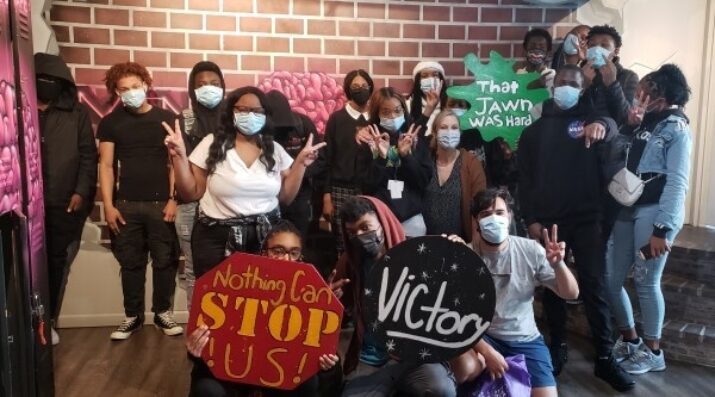
Together, educators are doing the reimagining and reinvention work necessary to make true educational equity possible. Student-centered learning advances equity when it values social and emotional growth alongside academic achievement, takes a cultural lens on strengths and competencies, and equips students with the power and skills to address injustice in their schools and communities.
When schools figure out how to serve students with the most significant challenges, they build practices and mindsets that make every student's experience better.
Progressive educators love renaming things. Think of all the labels we’ve used to describe the stuff you have to be good at to succeed at work or in college: 21st century skills, soft skills, non-cognitive skills, future ready skills, deeper learning competencies and more recently, durable skills. It can be hard to keep up with the lingo!
So when we say that at the Workshop School we are very particular about how we think of “special education” versus “exceptional education,” we’ll understand if your first impulse is to roll your eyes. In this case, though, it's not just semantics. The shift in language reflects a shift in mindset—one that's changing how we serve students with IEPs and, in the process, pushing us to rethink how we serve everyone.
Love the People, Know the Systems
After two-plus decades in education working across multiple school settings, we’ve learned that you can't serve kids with passion alone. You can't love kids without loving the work that comes with the kids. The paperwork, the compliance, the progress monitoring—these aren't obstacles to the real work of serving students. They're part of the promise we make to kids and families. They ensure accountability. The challenge is doing all of that while never losing sight of the humans at the center.
We think about it as managing two channels: exceptional ed and special ed. Exceptional ed is the humanistic approach—the relationship-building, the collaboration, the attention to each student's strengths and goals. Special ed is the compliance, the deadlines, the legal requirements. Both are essential but they serve very different purposes, and it is critically important that we not confuse the two.
Exceptional ed communicates to students and families that they are seen and heard, and that we are leveraging our creativity and resources to the best of our ability to help them grow. It is both empathetic and challenging, focusing on what students can do with the right support rather than their deficits.
Meanwhile, special ed translates that desire into accountability and measurable goals. This demonstrates to families that we mean what we say. Just as importantly, it takes the qualitative conversations we have about students and aggregates them in a way that aligns with regulatory and legal requirements. This takes a ton of time and energy, but we can’t wish it away. If we don’t do the special education stuff correctly, we end up in endless meetings with administrators, lawyers, and advocates. Doing a bad job on compliance ensures that we spend more time on it, not less.
From Coordination to Collaboration
Special education requires coordination. Everyone has a specific role to play in showing that we are providing students with the support that we say we will. This can be done well or poorly, but it often reinforces the sense that the work happens in silos. Each person literally has boxes to check.
Exceptional ed thrives on collaboration. Every Wednesday, the entire staff meets—sometimes in grade-level groups, sometimes in team meetings, sometimes in breakout sessions. Teachers complete input forms that generate data on each student's progress across classes. The exceptional ed team regularly observes in classrooms, not to evaluate teachers but to understand students more deeply. Our observations become the starting point for a conversation about strategies to build on their strengths and address their needs.
The more we are working together organically, the easier it is to check in on students, share insights about what’s working, or course correct as needed. A lot of the real collaboration happens in the hallways, during planning periods, and in casual check-ins. We overcommunicate sometimes. In a field where information gaps can mean the difference between success and failure for a student, that's not the worst problem to have.
Exceptional Education Drives Family Engagement
Parents and guardians know their kids. Many have been engaged with the special education system for years. They can tell you their child’s goals, specific learning interventions—anything about their kid. When parents feel truly heard and see their input valued, they become invested partners in their child's education. And that investment ripples outward—many of our most engaged families become the school's biggest supporters, showing up not just for meetings but for teacher appreciation events and school activities. In this way, doing exceptional education well doesn’t just help students with IEPs, it strengthens family engagement schoolwide.
Parent meetings are a valuable opportunity to translate special education compliance into exceptional education practice. For families, IEPs can feel like signing a contract you don't understand—you're agreeing to something important without really knowing what you're agreeing to. That breeds distrust, and too often shifts the focus from the student to the paperwork.
Pennsylvania requires a document called the NOREP—the Notice of Recommended Educational Placement—that distills the entire IEP into plain English on a single page. We tell parents, "this page right here explains all that noise over there." It ensures they understand exactly what services their child will receive, how much time they'll get, and whether they'll be pulled out or supported in the classroom.
Designing for Equity
When we train staff on accommodations and modifications, we try not to frame it as "special ed strategies." Instead, we ask: How do we make learning equitable for everybody? Consider a student who needs glasses. That's an accommodation—magnifying text on the board. Do we only do this for students with IEPs? Of course not. When you magnify text on the board, you help both the student receiving vision services and the general ed student who's too shy to say they're struggling to see. Design for your most challenged learners, and you create conditions where everyone can succeed.
What you do well in exceptional ed benefits your entire school, and what you do badly hurts everyone. When you figure out how to serve students with the most significant challenges, you build practices and mindsets that make every student's experience better. When you marginalize or stigmatize students with IEPs, you create a culture where all students are less safe, less known, and less able to bring their full selves to school. Ultimately, that disrupts both culture and academic growth for everyone.
Designing for equity is a foundational principle at Workshop. Nearly all of our students have faced economic hardship, and many have had negative experiences in elementary and middle school. About 40 percent of our students have an IEP. On top of that, our school is part of a large district that has historically struggled to support and sustain innovation. All of this can create conditions that make it challenging to fulfill our mission, but it also creates opportunity: the things that work here can work anywhere.
By getting exceptional education right, we make our whole school better. And as we get better, we create a proof point for other schools and systems. Like the shift from special to exceptional education, the effect is to move the conversation from merely what is required to what is possible.
Photo at top courtesy of the Workshop School.
Constance Lumb and Matthew Riggan
The Workshop School
Constance Lumb is the exceptional education director at the Workshop School.
Matthew Riggan is the Workshop School’s co-founder and executive director.