Finding Their Voice: Empowering Non-Verbal Students through Communication

Kristen Liedtke
Educator, Coach, Mentor
Modern Classrooms Project
in Troy, Illinois (Greater St. Louis Area)
Topics
Together, educators are doing the reimagining and reinvention work necessary to make true educational equity possible. Student-centered learning advances equity when it values social and emotional growth alongside academic achievement, takes a cultural lens on strengths and competencies, and equips students with the power and skills to address injustice in their schools and communities.
Three essential shifts can help educators rethink ‘student voice’ and create an inclusive classroom for non-speaking or minimally-speaking students.
What is the most fundamental characteristic of being human? It is the drive to connect, to share, and to be understood. When we design classrooms based solely on verbal speech, we are inadvertently denying a population their primary human right. How do we rebuild our educational spaces so that speech, symbols, gestures, and eye gaze are all equally respected paths to communication?
The primary challenge for non-speaking or minimally speaking students in traditional education is a profound communication mismatch. Traditional environments are fundamentally designed around the speed and structure of spoken language, often failing to recognize or accommodate alternative output methods. These methods can include text-to-speech, symbol selection, or eye-gaze technology. When their teachers and peers prioritize speed and verbal fluency, students who rely on these communication methods feel unheard, misunderstood, and isolated. Think how frustrating it must be to constantly be overlooked, talked over, ignored. The impact this has on students' learning is devastating.
True inclusion requires viewing communication not as a singular skill (speech) but as a diverse ecosystem. To create a truly inclusive environment, let’s dive into three essential educational shifts that can change everything:
Treating AAC (Augmentative and Alternative Communication) not as a mere support tool but as the individual's primary means of expression.
Building learning environments where speech, text, symbols, gesture, and eye gaze are all natural, accessible options for everyone.
Centering students' interests, creativity, and unique abilities instead of framing communication differences as deficits.
Educational Shift #1. AAC: From Tool to Voice
AAC stands for Augmentative and Alternative Communication. Simply put, it is all the ways people can communicate besides speaking. It includes any tool, system, or technique used to supplement (augment) or replace (alternative) speech or writing for people with temporary or permanent communication difficulties. Every human being has the right and the need to communicate their thoughts, feelings, needs, and ideas. When speech is difficult, AAC is the method that makes that full expression possible.
AAC is diverse and often referred to as multimodal, meaning a person uses a combination of methods:
Unaided AAC (No equipment): Communication that uses only the individual's body. Examples of unaided AAC can include gestures, body language, facial expressions, manual signs, or vocalizations.
Aided AAC (External support/equipment): Communication that requires tools or devices.
Low-Tech/No-Tech: Non-electronic methods that are always available. Examples can include communication boards, picture books, alphabet/word boards, or pen and paper.
High-Tech: Electronic devices that can generate speech. High-tech examples include dedicated speech-generating devices (SGDs) or tablets/iPads with specialized communication apps (like Proloquo2Go or LAMP), accessible via touch, switch, or eye-gaze tracking.
The AAC Mindshift: Old Concept vs. New Concept
| The OLD Concept (The "Tool" Mentality) |
The NEW Concept (The "Primary Expression" Mentality) |
| To support basic needs/requests. To act as a backup when spoken language fails. | To enable full linguistic expression. To provide a voice for complex ideas, humor, social commenting, and identity. |
| As a last resort. Often waited until all attempts at spoken language failed. | As a first right. Introduced as early as possible (sometimes in infancy) to establish a strong language foundation. |
| Required skills. Belief that a user needed to pass cognitive, age, or motor tests before receiving an AAC system. | Presuming Competence. There are no prerequisites. Every human is capable of communication and deserves access to a robust system. |
| Fear it blocks speech. The misconception that using an AAC device will stop the person from trying to talk. | It supports speech. Research shows that AAC often aids in the development of spoken language and reduces communication frustration. |
| Limited vocabulary. Focused only on "want/don't want" words (fringe vocabulary). | Robust vocabulary. Includes a wide range of Core Words (small, common words like I, like, go, not, feel) necessary to form endless sentences. |
| Sources: AAC-Plus. (n.d.). Core Words vs. Fringe Words: What Matters Most for Beginners. American Academy of Pediatrics Council on Children with Disabilities and American Speech-Language-Hearing Association. (2025). Augmentative and alternative communication for children. HealthyChildren.org. Janice Light, David McNaughton & Jessica Caron (2019): New and emerging AAC technology supports for children with complex communication needs and their communication partners: State of the science and future research directions, Augmentative and Alternative Communication, DOI: 10.1080/07434618.2018.1557251 |
|
Honoring Communication Pacing: Embracing Silence
The key to honoring an AAC user's pacing is to acknowledge that communication formulation takes time, especially when navigating a device or communication board. This time is not wasted; it's essential for a student’s linguistic processing and motor planning.
Why Pacing is Critical
Motor Demands: Unlike spoken speech, which is largely automatic for verbal speakers, using a device requires the AAC user to manually select symbols, which can involve complex motor sequences (e.g., navigating folders, pressing multiple buttons). This can be physically and mentally demanding.
Processing Load: The user is often thinking, "What do I want to say?" and "How do I say it with my system?" simultaneously. This dual-task load requires significant processing time.
Preventing Learned Helplessness: If a conversation partner consistently jumps in or finishes the sentence, the user quickly learns that their effort is unnecessary, leading them to stop initiating communication.
Actionable Tip: The 10-Second Wait
The "Stop interrupting" tip is excellent. This can be so hard to do in practice, so put a structure to it. Enforce the 10-Second Wait Time (or more, if the user requires it) for yourself and others in your classroom.
After you ask a question: Wait a minimum of 10 seconds of silence. Use a mental count or a visual timer if needed. Avoid making eye contact the entire time, which can feel like pressure; instead, show attentive body language and let the silence hang.
After the user begins: If the user activates their device once but then pauses, wait another 10 seconds. They are likely searching for the next word. Do not prompt, point to a symbol, or offer the word they might be looking for.
Educational Shift #2. Universal Design for Learning (UDL) in Communication
The educational shift to next gen learning makes the integration of Augmentative and Alternative Communication (AAC) a foundational element. This approach prioritizes personalized, student-centered, and universally accessible education by moving beyond merely accommodating a single student. Instead, it requires educators to design the learning environment for diverse communication needs from the start.
The UDL Principle: Designing for Universal Access
Universal Design for Learning (UDL) is a framework that guides the design of learning environments to make them accessible and engaging for all. UDL is built on three core principles:
Multiple Means of Representation: Presenting content in various ways (e.g., visual, auditory, tactile).
Multiple Means of Action and Expression: Offering students various ways to respond and demonstrate what they know.
Multiple Means of Engagement: Providing different ways to motivate and sustain learning.
When applied to communication, the UDL principle ensures that the learning environment is designed for the "margins," meaning that a communication solution designed for a non-verbal student (e.g., an accessible visual communication board) often benefits everyone, such as non-native speakers, students with temporary speech impediments, or visual learners. The goal is to make communication modality inclusion the norm, not the exception.
Normalizing Multiple Modes of Communication
A next gen learning environment intentionally builds lessons where multiple communication modes are always available and encouraged for all students. This normalizes the use of AAC devices and low-tech options, making a student's communication method an integrated tool, not a separate, stigmatizing one.
Examples of Integrated Modalities:
- Response Options: Students can demonstrate their understanding of a question by:
Speaking (verbal response).
Typing their answer on a shared digital document or projected screen.
Pointing to an answer on a physical core vocabulary or picture board.
Using their AAC device to generate a spoken or typed message.
Using a gesture (e.g., a thumbs-up for agreement, pointing to a choice).
- Presentations and Expression: Students are given the freedom to choose a presentation format that leverages their strengths and preferred communication modes:
Using their pre-programmed AAC phrases to deliver their presentation script.
Creating a presentation where they use a text-to-speech app or pre-recorded voice for narration.
Relying primarily on visual aids, gestures, and movement to convey information.
Designing the Physical and Digital Space
True UDL communication requires thoughtful design of both the physical and digital learning environments.
Low-Tech Everywhere: Ensure physical core vocabulary boards are mounted, visible, and accessible in every area of the school, including classrooms, the gym, the cafeteria, and the playground. This ensures communication is not dependent on a high-tech battery-powered device.
Tech Integration: Seamlessly integrate AAC devices into daily activities. For example, during group discussions or read-aloud time, project the AAC user's device screen onto the classroom's smart board. This allows all students to see the symbols being selected and promotes peer understanding of the system, turning the device into a public tool for learning.
Leveraging Consistency over Proficiency
The Goal Is Exposure, Not Mastery: Staff and peers don’t need to be fluent AAC users. Their primary role is to be consistent communication partners who provide frequent, correct modeling of the system. Just as a child learns spoken language by hearing it modeled by parents, the AAC user learns the system through repeated exposure from partners who simply use the device as they speak. The consistency of this input is what drives language acquisition, not the communication partner's mastery of the device's full vocabulary.
UDL Reduces the Training Burden: When the learning environment is designed using UDL principles (e.g., low-tech boards are visible, the AAC screen is projected, multiple response options are normalized), the communication burden is shared and the cognitive load on staff is lowered. They don't need to memorize every path to every word; they only need to use the readily available, visible core vocabulary for modeling during everyday interactions. This systemic approach is what makes the UDL mindset scalable and successful.
The User Is the Expert: The ultimate goal is for the AAC user to be the expert of their own system. Consistent modeling provides the language map, but the user's intent and expression should always be prioritized. Success is measured by the user's ability to communicate, not the communication partner's fluency.
Educational Shift #3. Strengths-Based Focus
This fundamental shift empowers us to move beyond the "disorder" label and actively build upon the student's natural talents and interests. We redefine success by valuing a student’s communication potential and honoring their unique abilities and interests.
Shifting the Lens from Deficit to Difference
A strengths-based approach requires eliminating deficit-based language (e.g., "non-compliant," "low-functioning," "disruptive") which often mislabels behavior that is actually a communication breakdown or a reaction to an inaccessible environment.
Embracing Neurodiversity: Focusing on neurodiversity means viewing differences in communication and processing as a valid, non-standard way of interacting with the world, rather than a broken system. The student isn't lacking—they just need access to the appropriate linguistic tools.
The Power of Presumption: By presuming competence (Mindshift #1), educators assume that students have complex thoughts and ideas, even if their current output is limited. This belief changes how teachers structure their interactions with students and how they measure success.
Leveraging Interests for Communication Growth
Communication is intrinsically motivated. By connecting AAC directly to a student's passions, you provide a powerful reason for them to learn and practice language.
Curriculum Connection: Use high-interest topics (specific sports, video games, historical events, art forms) as the primary engine for language instruction and practice. If a student is highly engaged with Minecraft or dinosaurs, they are motivated to use their AAC system to discuss, question, and express opinions on those topics.
Actionable Tip: Program vocabulary related to the student's favorite hobbies first. Prioritize "fringe vocabulary" (topic-specific words like creeper, fossil, asteroid) that allows them to communicate what they want to say, integrating these with essential Core Words (e.g., I, want, make, go).
Realizing Full Potential
An AAC system can often unlock creativity and talent that may be masked by motor or speech difficulties.
The Device as an Enablement Tool: Students who struggle with the physical demands of handwriting or speech articulation may excel at forms of expression that rely on the structured output of their device. This includes detailed writing, digital art creation, music composition, or coding where their cognitive strengths can be leveraged.
Example: A non-verbal student can use their AAC system to write complex poetry, direct a play by providing instructions and lines, or debug code by typing commands quickly, demonstrating academic and artistic abilities that transcend verbal communication.
Measuring Success beyond Speech
Success in AAC should never be measured by the frequency of spoken words. That metric focuses on the deficit.
Redefine Success: Define true success as growth in communicative intent (purposeful communication), initiation (starting a conversation or expressing an idea spontaneously), and the complexity of expression (using multi-word messages, humor, expressing abstract concepts, or asking questions).
Focus on Function: The measure of success is whether the student can successfully participate in all areas of their life—academically, socially, and emotionally—using their AAC system as their primary, robust voice.
Scenario #1: Student Sharing Personal Interest in a Group Project
Engagement
The Situation: A middle school class is starting a project where students choose a topic of personal interest to research and present.
The AAC/UDL Success: A student with a communication device who typically stays quiet uses their speech-generating device to select pre-programmed vocabulary to initiate a conversation with their group members. They use the device to share their passion for a niche topic (e.g., deep-sea creatures). The UDL principle of providing choice in content and tools empowers the student to lead their part of the project, increasing their self-determination and motivation. The device serves as an effective communication channel to build relationships with peers.
Scenario #2: Understanding Literary Themes
Representation
The Situation: A high school literature class is discussing the theme of "courage" in a novel. The teacher is using spoken lecture and written text.
The AAC/UDL Success: The teacher uses visual aids (e.g., a graphic organizer connecting courage to character actions) and audio descriptions of key concepts. A student using an AAC tablet with symbol-supported language can follow along, as the symbols on their device visually reinforce the abstract vocabulary (e.g., the symbol for "courage" or "theme") the teacher is using, aiding comprehension. They can then use their device to ask a clarifying question or make a comment.
Scenario #3: Participating in a Science Lab
Action and Expression
The Situation: A science class is conducting a lab experiment where students must verbally state their hypothesis and record observations.
The AAC/UDL Success: The UDL principle allows for multiple methods of expression. The teacher accepts various ways of expressing a hypothesis. A student with limited verbal output uses their speech-generating device to vocalize their hypothesis by combining pre-programmed core words and fringe vocabulary. For recording observations, they use a low-tech option, a picture-based communication board on a clipboard, to select and point to symbols representing changes (e.g., "color change," "more bubbles," "hot"). This ensures the student participates fully in the fast-paced activity and proves their understanding.
Scenario #4: Presenting a History Report
Action & Expression
The Situation: A student needs to present a report on a historical figure.
The AAC/UDL Success: Instead of a traditional verbal presentation, the student uses their AAC device to deliver their report. They prepare the text beforehand, practicing the timing of the speech output. The teacher, following UDL, explicitly accepts this form of presentation, recognizing the speech generating device as a fully functional voice. The student is assessed on the content and organization of the report, not the method of verbal output, ensuring a fair and equitable evaluation. This boosts the student's confidence and validates their communication method.
Scenario #5: The Morning News and Sharing
Action & Expression
The Situation: A second-grade class is having "Morning News" or "Sharing Time," where students take turns sharing an experience or piece of news from home and answer one question from a peer.
The AAC/UDL Success: A student who uses a low-tech communication book or a high-tech AAC device for communication is given their turn to share. Instead of speaking aloud, the student successfully points to a sequence of symbols/presses buttons on their device to construct and deliver their news (e.g., "I went to the [symbol for park] yesterday. I liked the [symbol for swing]"). When a peer asks a follow-up question ("Was it sunny?"), the student uses their device to respond ("Yes"). The teacher, following UDL, explicitly accepts this form of communication, understanding that the AAC system is the student's voice. The student is assessed on their ability to communicate information and engage in social exchange, not on their verbal speech output. This ensures their full participation in a key classroom social routine and validates their communication method, boosting their confidence and sense of belonging.
Inclusive Communication Practices
The three essential mindshifts required for next generation learning that embraces truly inclusive communication are centered on a singular belief: every individual has a right to a unique, robust voice.
The revolutionary change starts today, with an honest assessment of your own practice and environment. I challenge you to immediately audit your communication space:
Measure the Silence: Today, after asking an AAC user a question, measure your wait time. Did you wait 10 seconds? Did you interrupt or anticipate their message? Embrace the silence to honor their right to form and deliver their message completely.
Check the Walls: Look around your classroom. Are low-tech core vocabulary boards visible and accessible in every essential area (not hidden in a drawer)? Are they covered or used? Normalizing the visuals normalizes the modality.
Identify the Talent: Ask your student(s) for three of their highest interests (not academic strengths). Program the essential vocabulary related to those interests into their system. Lead with passion to motivate complex communication.
The greatest disservice we can do to any student is to silence their mind. By embracing these shifts, you are doing more than implementing a strategy; you are leading a movement. You are helping to provide the keys to language, access, and identity for individuals who are not waiting to learn how to think, but are simply waiting to share their complex, brilliant, and unique thoughts with the world.
Unlock their voice, and help unlock their future.
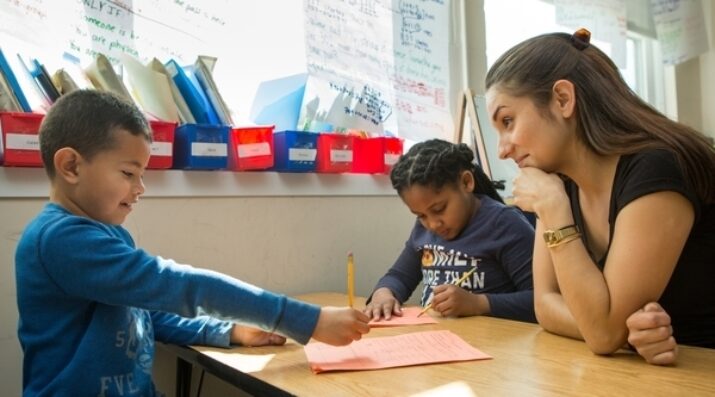
Photo at top by Allison Shelley/The Verbatim Agency for EDUimages, CC BY-NC 4.0
Kristen Liedtke
Educator, Coach, Mentor, Modern Classrooms Project
Kristen A. Liedtke, M. Ed., is an educator, coach, and mentor with a diverse background encompassing over fifteen years of experience in education, business, finance, and professional development. Kristen holds a bachelor’s degree in business administration, a master’s degree in education, and 24+ hours above while working on a degree in special education. She is skilled at evaluating student needs and creating individualized plans to facilitate success. Her capabilities include developing and implementing educational interventions, providing direct student support, and training staff. She is experienced in designing instructional materials through a systematic task analysis process to facilitate successful learning outcomes. Liedtke has also demonstrated strong leadership and organizational abilities, including mentoring and coaching educators and developing and implementing professional development activities. Her teaching experience is augmented by her background in business and finance, providing her with a unique perspective on the practical application of knowledge and the importance of effective communication. Follow Kristen on LinkedIn.