From Procedural to Conceptual: Reframing Math to Bolster Confidence
Kelli Easterly
Managing Director of STEM
Distinctive Schools
in Chicago, Illinois
Topics
We’ve all had the experience of truly purposeful, authentic learning and know how valuable it is. Educators are taking the best of what we know about learning, student support, effective instruction, and interpersonal skill-building to completely reimagine schools so that students experience that kind of purposeful learning all day, every day.
Math is the architect of the universe but it is often taught as a race to one right answer rather than an ability to tell stories about the natural world with numbers.
In many classrooms, math is seen as a gatekeeper—a subject that arbitrarily decides who is "smart" and who isn't. A different vision moves beyond math as a school subject to seeing math as a universal language and tool for economic mobility. My vision for math at Distinctive Schools is to shift the narrative from "solving problems" or memorizing a formula, to authentic problem-solving and navigating a complex world. We want our scholars to see math as a way to understand the predictable patterns of the universe as a pathway to solutions and, more importantly, the pathway to their own future success.
The world is changing at an unprecedented pace—STEM jobs are projected to grow more than 8 percent over the next 10 years, nearly triple the rate of other fields. The financial implications of this are staggering: the median wage for STEM roles exceeds $103,000, while non-STEM roles sit closer to $48,000. That $55,000 annual gap represents opportunity, stability, and the power to impact one’s community and life trajectory. Having strong math competencies is a pathway to success for students after high school. In fact, research indicates that math proficiency in early adolescence is the strongest predictor of adult earning potential. We know that for students—particularly for girls, Black, and Hispanic students—improving math scores is a critical lever for closing this gap. When a scholar realizes they can master math, they are reclaiming their agency in a data-driven world.
It makes me wonder: if the rewards are so high, why is math still treated as a source of anxiety rather than a tool for discovery? In my observations, it is because we often teach math as a race to a single "right" answer, stripped of its real-world connection. As a scientist, I see math differently. While English Language Arts helps us communicate ideas, math is the thing that makes sense of science. It is the architecture of the universe and the blueprint for our students' future success.
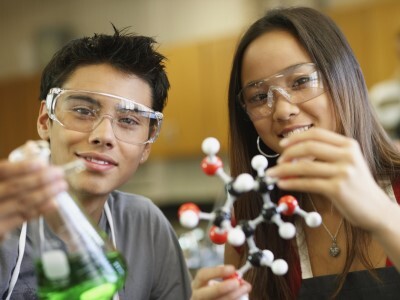
The reality is that math is all around us, explaining every interaction in the natural world. From the symmetry of a snowflake to the spirals of a sunflower’s seeds, math connects us to everything in nature. To truly understand science, we must understand why the math works. Numbers are simply symbols representing something tangible. When a scholar understands how these symbols work to explain a physical interaction, they are getting at the core of why science matters.
In elementary and middle school classrooms across Distinctive Schools, we are moving toward "telling stories with numbers." This means shifting our focus to what the symbols actually represent: understanding that a “4” is not just a digit on a page, but four of something tangible, and that "x" is a specific placeholder for a real-world unknown. When a student attaches a symbol or a variable to a problem, they are manipulating that "something" in a very specific way to solve a real-world mystery. This transition to authentic problem-solving allows students to see math in action, whether they are using rotations and reflections to understand the complex mechanics of a human spine or calculating the precise arc of a basketball jump shot.
Looking at math scientifically opposed to procedurally requires a shift in mindset. Here are a few ways teachers can embrace that “science mindset” in their math classes:
Always come back to why specific mathematical models, procedures, and equations make sense. The universe (and the math that explains it) operates in predictive ways and students will be more prepared to transfer their learning to new situations when they understand these predictable behaviors.
Teach the equal sign (=) as an indicator of equivalence and balance as opposed to an indicator of “the answer” after calculations. This will promote a relational mindset between the two sides of the equation and prime students for the relational reasoning needed in algebra and beyond!
Leverage the natural function of students’ brains by prioritizing retrieval practice over repetitive counting to transition their math processing from the prefrontal cortex in the brain to the hippocampus, and eventually neocortex. Essentially, use the natural wiring of the brain to help advance learning math in a natural way. This will free up space in the prefrontal region for complex problem solving.
When we prioritize the "why" over the "how," we move from procedural memorization to conceptual curiosity. By focusing on what math means as a scientist—as a way to decode the predictable patterns of the universe—we provide scholars with the pathway to their own future success. Let’s stop asking students to find x and start helping them use math to find their path in a world that depends on it.
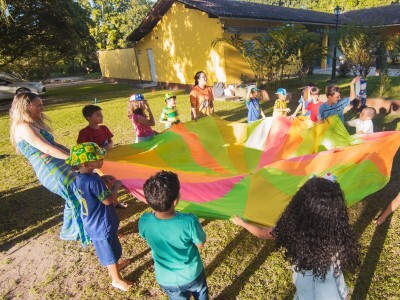
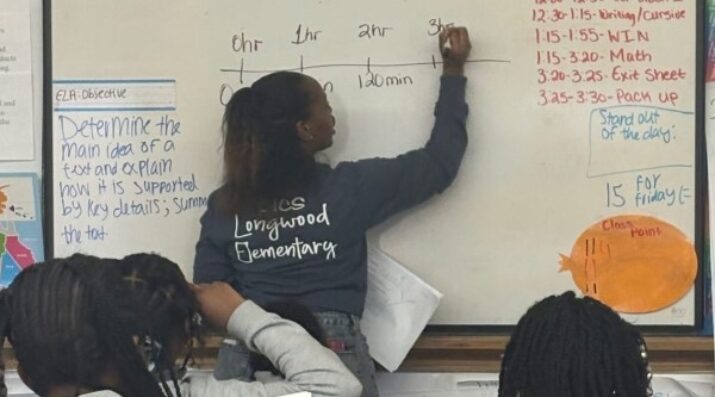
Photo at top courtesy of Distinctive Schools.
Kelli Easterly
Managing Director of STEM, Distinctive Schools
Dr. Kelli Easterly serves as the managing director of STEM at Distinctive Schools, where she leads the design and implementation of high-quality, future-ready learning experiences. With an extensive background in systems-level leadership, including her previous tenure as the executive director of STEM for Chicago Public Schools, Dr. Easterly is a dedicated advocate for equitable access to rigorous STEM pathways and instructional coherence. Her unique perspective on applied science is informed by a multifaceted career that includes owning a chiropractic practice, serving as a director of basic sciences, and developing curricula for major publishers. She holds a Doctor of Chiropractic from National University of Health Sciences, an M.A. in Teaching from National Louis University, and a B.S. in Biology from DePaul University.