Signal Strength: When Learning Survives Beyond the Bell

Donna Lynn Germano Phillips
SEAD and Special Education Leader
in Nevada
Topics
We’ve all had the experience of truly purposeful, authentic learning and know how valuable it is. Educators are taking the best of what we know about learning, student support, effective instruction, and interpersonal skill-building to completely reimagine schools so that students experience that kind of purposeful learning all day, every day.
What do students remember from your lessons each day? Here's how you can help them focus on what matters to support meaningful, and enduring, learning.
Some days, teaching feels like holding a hundred small pieces of a puzzle together at once.
The schedule is tight, the standards are real, and the needs in the room are louder than the clock. And there are mornings I walk in knowing I’m prepared—yet still not fully sure what I want students to leave with.
That’s when learning gets blurry for students. There have been days when my students completed every step of the lesson, packed up their materials, and still asked, “What are we doing?” Not because they weren’t trying—but because nothing had a chance to land before the bell.
That’s when I realized the lesson wasn’t too hard. The signal never really had a chance to hold. It wasn’t reaching students through the noise of the moment.
Over time, I’ve learned something that reshaped how I plan lessons—especially in a self-contained classroom: when learning doesn’t offer a visible anchor, students don’t just disengage. They gravitate toward something else and create their own way through the moment.
Not in a negative way. In a human way. They latch onto what feels predictable or immediately clear—finishing the task, copying the board, following the routine. They follow the strongest signal available in the moment, even if it isn’t the one we intended.
And honestly, that makes sense.
Teaching with Tomorrow in Mind
There’s a line I come back to often: “Today was once the tomorrow I worried about yesterday.”
In the classroom, that reminder matters. It helps me slow down—not to do less, but to teach with intention. To think beyond finishing the lesson and toward what students might still carry with them later. Because when the bell rings, the worksheet stays behind. The slides disappear. What students leave with is whatever feels important enough to notice.
That’s where signal strength comes in.
What Signal Strength Really Means
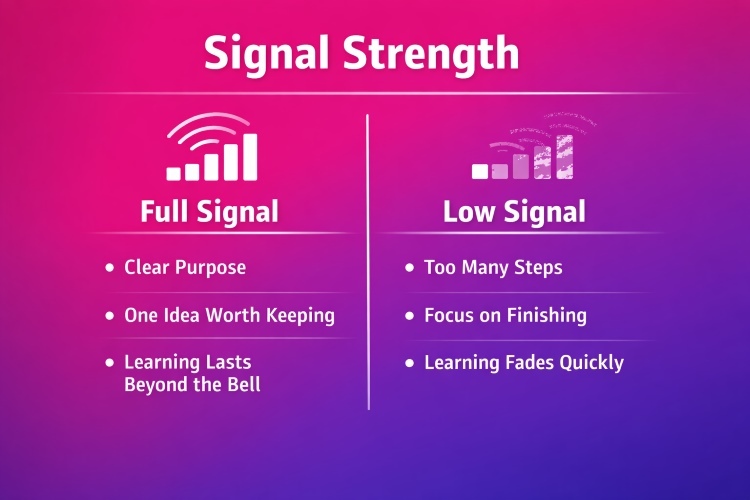
Signal strength isn’t about flashy lessons or perfect pacing. It’s about whether the core idea of a lesson is strong enough to be:
- noticed,
- remembered,
- and used again.
When time is limited, students don’t absorb everything. Students pick up signals. The question is which ones. Is the strongest signal:
- finish the task,
- follow the steps,
- and wait for the next prompt?
Or is it:
- this idea matters,
- this helps me think,
- and this is something I might use again?
Clarity from the teacher doesn’t always translate into clarity for students. A lesson can look organized and still feel confusing, especially when students are focused on copying rather than understanding. When time runs short, the signal students follow is often the one we didn’t intend. Class is over. The lesson was taught—but where did the learning land? What’s left is confusion, stress, and a missed chance to talk it through before the bell.
When time is short, being precise about what matters isn’t extra. It’s the difference between learning that disappears when the bell rings—and learning that quietly shows up the next day.
The Part We Forget
Somewhere between pacing guides, standards, scaffolds, and the clock on the wall, it’s easy to forget one simple truth: Students don’t experience lessons the way teachers design them.
Teachers see objectives, steps, and supports. Educators bring thoughtful ideas and real care into their lessons.
Students experience moments. The moments that stay with them are the ones shaped to feel meaningful and memorable.
A direction.
An example.
A pause—or the lack of one.
When time gets tight, lessons don’t fall apart. They narrow. And what remains is the strongest signal students can detect at that moment. That’s not a failure. That’s how learning works under pressure.
Where Signal Strength Actually Lives
Signal strength doesn’t get added to a lesson plan as one more thing: It lives inside the decisions teachers already make. Every teacher asks these questions while planning:
- What do I model?
- What do I cut if time runs out?
- What do I repeat?
- What do I leave unsaid?
Those choices shape what students notice.
Instead of asking,
Did I cover everything?
The question becomes:
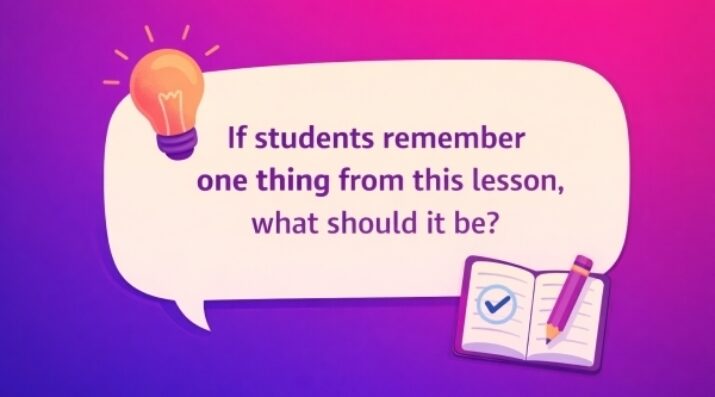
If students remember one thing from this lesson, what should it be?
That single question changes decisions without adding time.

What Signal Strength Looks Like in Real Classrooms
Sometimes the shift is small. Keeping one example instead of three—the one that shows why the skill matters, not just how it works. Sometimes it’s choosing a closing question instead of another reminder:
- “Where might this help you again?”
- “What felt worth remembering today?”
- Or better yet, a simple invitation: “Tell me more.”
Sometimes teachers let a moment sit instead of filling it. This builds opportunities for student-led choice and voice.
Same lesson.
Same time.
Stronger signal.
Why Signal Strength Matters—Especially When Time Is Tight
I teach self-contained students, where time is especially precious and support needs are high. There’s no room for filler, and no room for learning that disappears once the task is finished. Instruction with intention—direct, visual, and modeled—gives learning a fighting chance to stick. Nothing groundbreaking—just easy to lose when time and pressure pile up.
But this isn’t just a self-contained issue. Every classroom faces the same reality: too much to cover, not enough time, and students who need clarity more than complexity. When learning has to survive the bell, signal strength matters!
A Final Thought
Teachers are already doing complex, thoughtful work under real constraints. Remembering to pause and ask what students are actually picking up—even briefly—can quietly change what stays with them.
Teaching the standard matters. Teaching students how to recognize what matters helps learning last. And sometimes, the most powerful shift isn’t changing what we teach. It’s getting clearer about what we want students to carry forward—today, tomorrow, and beyond the bell.
All images courtesy of the author.
Donna Lynn Germano Phillips
SEAD and Special Education Leader
Donna Lynn Germano Phillips, M.Ed., is a SEAD (social, emotional, and academic development) champion with Mindful SEAD, a licensed SEAD specialist, autism mentor, and a leader in SEL (social-emotional learning) and special education. She serves on the Nevada State Superintendent Teacher Advisory Cabinet (STAC) and is a published writer. As a self-contained special education coordinator and lead, Donna is also a national speaker for Mindful SEAD Summits, where she empowers educators to integrate SEL and SEAD strategies effectively into their classrooms. LinkedIn