Why Do We Walk? Why Do We Teach?
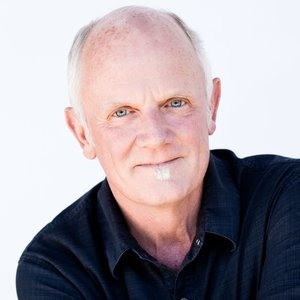
John Watkins (he, him, his)
Education Coach and Consultant
in Oakland, California
Topics
Next generation learning is all about everyone in the system—from students through teachers to policymakers—taking charge of their own learning, development, and work. That doesn’t happen by forcing change through mandates and compliance. It happens by creating the environment and the equity of opportunity for everyone in the system to do their best possible work.
Some metaphors for a long teaching career from a long walk in the Pyrenees
“For the simplicity on this side of complexity, I wouldn't give you a fig. But for the simplicity on the other side of complexity, for that I would give you my life.”
–Supreme Court Justice Oliver Wendell Holmes
Introduction to the Pyrenees and the GR10
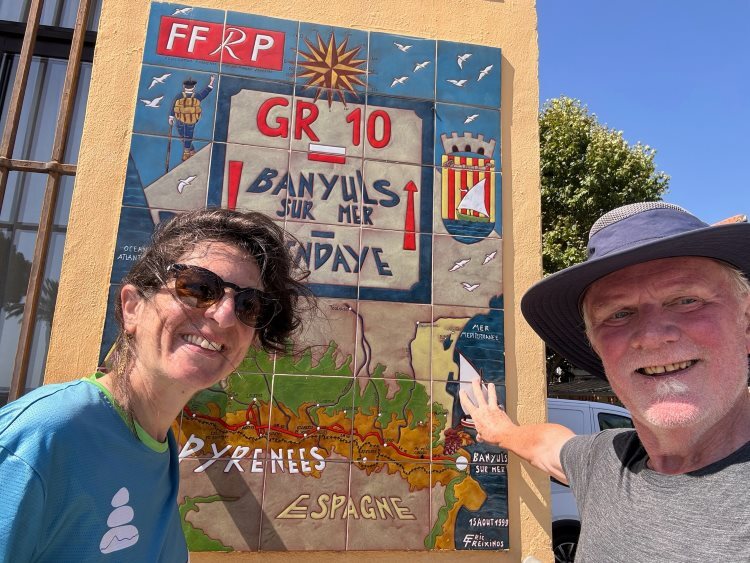
In 2022, my wife, Jessica, and I walked the first half of the GR10, a 950 kilometer Grande Randonnée trail on the French side of the main ridges of the Pyrenees. The GR10 starts with dipping your toes in the Atlantic in the little town of Hendaye and ends similarly in the sea-side town of Banyuls-sur-Mer on the Mediterranean. That year, we made it halfway, to Bagnères-de-Luchon. Along our way a number of metaphors about walking occurred to me that I then wrote about to help guide the long journey of school and school system transformation.
This year (2026), Jessica and I returned to complete our journey to the Mediterranean, 473 kilometers, or 294 miles, over the complex terrain of the deeply glacially carved northern slopes of the eastern French Pyrenees. “Deeply glacially carved” means that daily we climbed up steeply out of glacial valleys and over the high cols and ridges in-between, and then back down again, for an overall elevation gain of 26,700 meters, or 87,598 feet up, during our five weeks of walking, almost the same as climbing Mt. Everest from sea level 3 times.
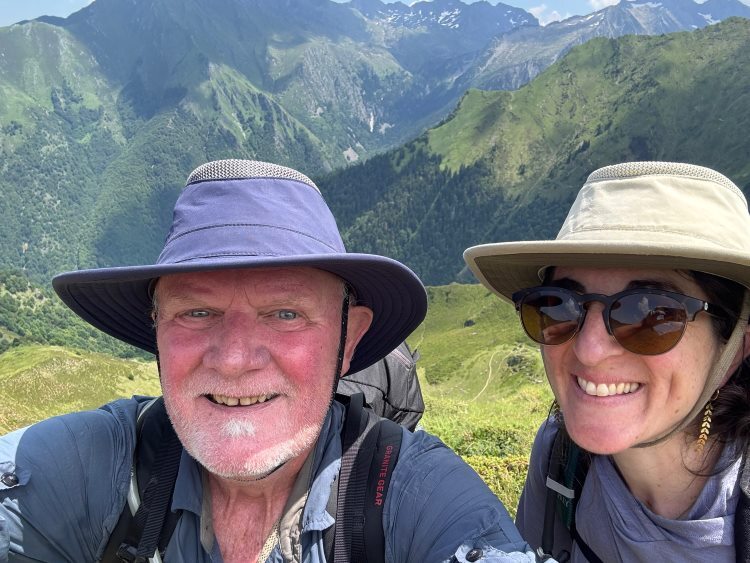
To say this was an incredibly challenging and also spectacularly beautiful trek would be a serious understatement. Walking such a route, with a pack and camping gear, tests everything about being in the wilds, being together with a partner and supporting each other, and even being human. This half of the GR10 turned out to be much more challenging and difficult than the first half, and it presented us with many opportunities to decide it was too hard, and to give up and go somewhere else where the walking might be easier. But we didn’t. We didn’t decide explicitly that we would make it to the Mediterranean, often responding to queries of that nature with, “On espère…” (“We hope so…”) but we did keep going each day, every day, except for a few deeply needed and appreciated rest days, and by the last week, our response had changed to, “Yes, we expect to be in Banyuls on the evening of the 16th of July.”
We started every day on the GR10 by reviewing the guidebook to see what the day might involve. But a guidebook is a highly simplified version of something very complex. Each step, each turn in the trail, each foot of elevation gain or loss, each forest, each slope, each meadow and pass, each stream to cross is unique, as is the experience each walker has, even differences in experience from moment to moment. About a week in, Jessica one morning said,
“This trail, each day, reminds me of the Oliver Wendell Holmes quote about complexity and simplicity. But it’s like that every day. It starts in the simplicity on this side of complexity, but in reality, every step is extremely complex, and the summation of steps is even more so. It’s only at the end of a day that you can begin to find the simplicity in that day. And then it starts all over again the next day.”
I think that was true of our GR10 walk, and it is even more true of teaching. So when we started to talk about why we walk, the answers started to feel like metaphors for why we teach.
Why Do We Walk?
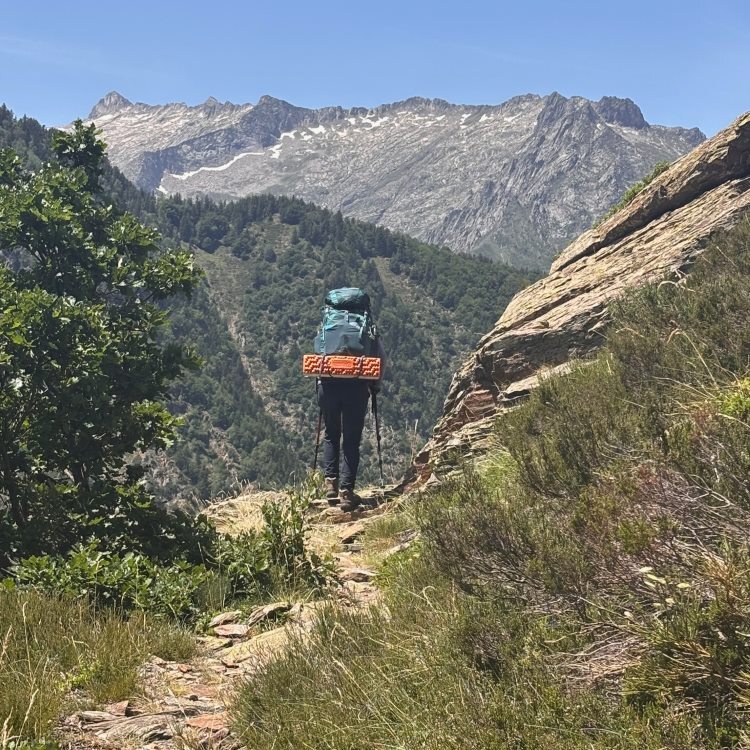
Along about the end of the first week, which no amount of conditioning could have prepared us for, and where every excruciating moment my body and mind screamed at me to give up and go elsewhere, Jessica one morning, as we were preparing to hoist our packs and head out, said, “I have a question for us to think about today…” “What?” I asked, a little annoyed. “Why do we walk?” she replied. I don’t think she meant it to be about quitting; I think it was more ontological. I took it that way: “Huh!” I said, “Good question!” and then did not say any more right away. I pondered her question all day as I painfully climbed up out of the glacial valley and up the steep ridge du jour. In the silence of our walking (we did not often talk much while we were walking; at first it was too hard, and we were concentrating just on breathing, and later it was often because Jessica walks faster than I do and we would be separated by a little distance on the trail; sometimes it was just that silence seemed to be the most intimate we could be, with ourselves and with each other), a number of answers came to me, and us as we began to talk them over, rather quickly:
We walk to cleanse toxins from the body; to burn them up in the fire of the trail
This isn’t just getting into shape; it’s a really deep experience of finding a more positive relation with one’s whole somatic experience: how have I been embodying myself? What embodied habits have been serving me well and which have not? Can I enter more deeply into relation with myself and the trail? Can walking this trail help me burn up the habits that aren’t serving me?
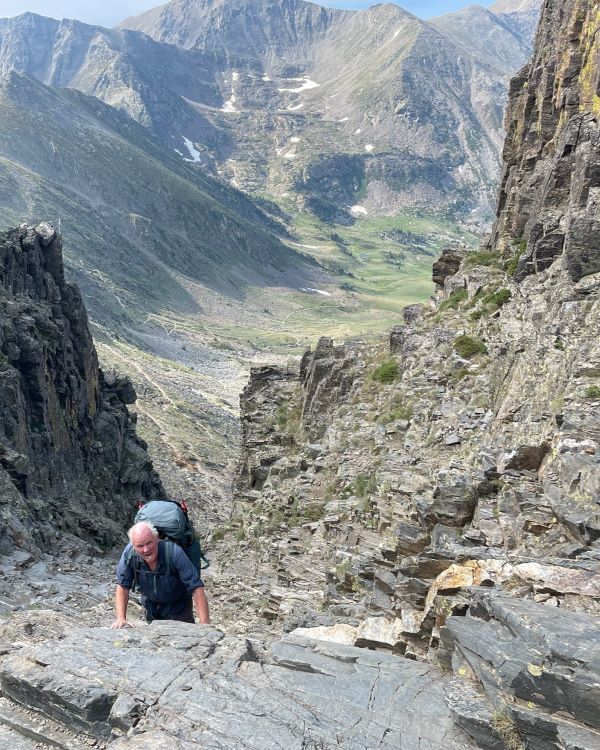
We walk to cleanse toxins from the mind; to burn them up in the fire of the trail.
I found myself reflecting on the large number of limiting beliefs, habits of thinking/being, negative patterns of thought that flowed through my mind as I walked. Why did I curse the trail, its rockiness, its steepness, its heat, whatever aspects of it I was encountering at any given moment? Why was I so weighed down by the horrific political situation in our country and the world? Why did I mentally respond to almost everything Jessica would suggest with an immediate “no,” even if I would later realize it was a really good idea? Can I burn these limiting beliefs and habits of mind that do not serve up in the intensity of the experience of coming to terms with the trail?
We walk to learn how to muster our spirit.
Modernity has made everything so convenient that we can live passively most of the time. We live in a “convenience economy.” Early in our walk, Jessica found a deep wellspring of power from a center low in her belly, but she had to learn to call it up. She said it was similar to the mustering she has to do in her teaching. It knits together her spirit and her physicality. She said,
“You have some will, some choice here. But you can’t bring just part of yourself to the situation. It’s a rawness, an anti-modernity. You’re saying to yourself, ‘Here’s the thing that’s not easy to do. And it’s not going to be just for a short time. It’s going to be a long time. And I’m going to bring myself fully to that.’”
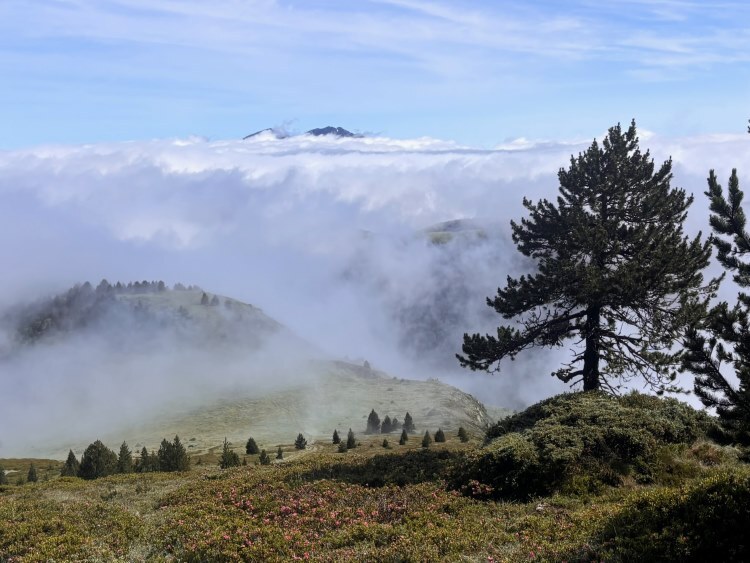
A few more days into the walk, once I started to get stronger and could breathe and think at the same time, other answers began to emerge:
We walk to cultivate a deeply multi-sensory experience of acceptance.
This one took a week or so more to get to, because I could not find any degree of acceptance while I was burning up somatic and mental toxins, or just getting strong enough to have the mental and physical space to allow any kind of acceptance. Getting to some kind of acceptance at its most basic meant being able to say to myself at every moment, “This [right now, right here, these footsteps, these rocks, and beyond here, that ridge, etc.] is the trail we have; this is the trail we chose to walk.” It was a profound realization.
We walk to experience creative openness (in the mind/body) to the situation we’re in.
This follows from cultivating acceptance. It’s the feeling of an inner expansiveness and outer sensitivity, like a breath of fresh air that expands one’s awareness of what’s happening around you, and the joyfulness of more flexible and generative inner (mental, physical, emotional) spaces.
We walk to experience gratitude.
One day after I had begun to feel that acceptance and creative openness, I was struggling with a particularly hard uphill climb on a very hot day, sweating profusely, when all of a sudden a very slight breeze wafted over me and was gone. But my experience of it was with such joy and delight I found myself actually calling out, “Oh wow! I’m so grateful for this little breeze!!” It sounds a little maudlin, but in that moment, it was profoundly joyful.
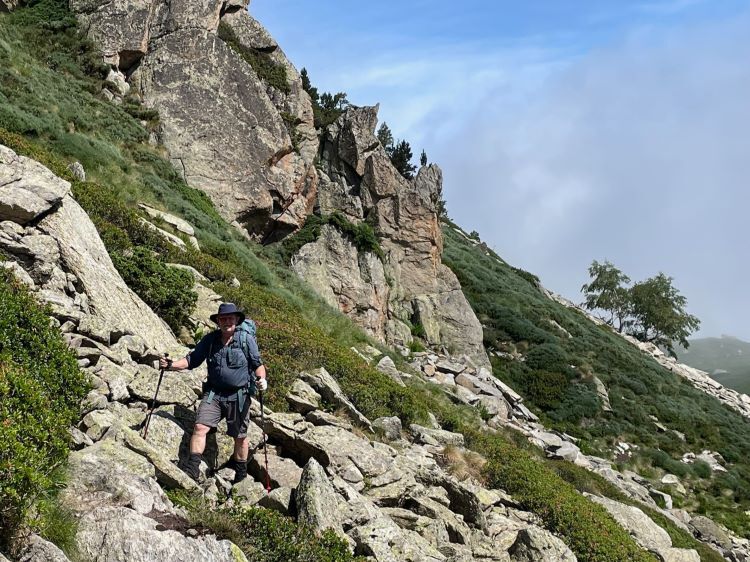
Then one evening, sitting on the deck of a refuge, with a small group of “trail friends,” people whom one meets along the trail or in refuges or gîtes, and even though we don’t actually walk together each day, we see again, maybe once, maybe for a number of days, in the evenings, Jessica decided to raise the question to the broader group: “Why do we walk?” she asked. They got it right away, eyes brightening, and then and for a number of evenings periodically through the rest of our trek, the conversation would continue, or iterate again with another group, and the answers poured forth:
We walk to learn to walk.
I might have been the first to say that, but it seemed to come from everyone that evening. Before the trip, I had been reading a little book by Thích Nhất Hạnh called, How To Walk. He means how to do walking meditation, or really, how to be in your daily experience with mindfulness. At the beginning, for me, it meant, how to put one foot in front of another to get somewhere that is very far from where you are starting and over difficult terrain. It was a kind of survival. Also it was about not twisting an ankle or stumbling over a rock or slipping into a stream, or worse, off the edge of a contouring trail on a steep slope. But it became more. That’s a longer story I’ll save for another time. Putting one foot in front of another is actually a pretty deep practice. To learn to put one foot in front of another is about paying attention to what’s right in front of you, the adjacent possible, the focus on little steps, iterations of practice on the way to deeper practice, the discipline of aware and reflective action, and only then to realize later on that you’ve actually gotten somewhere you wanted to get to, and learned something along the way…
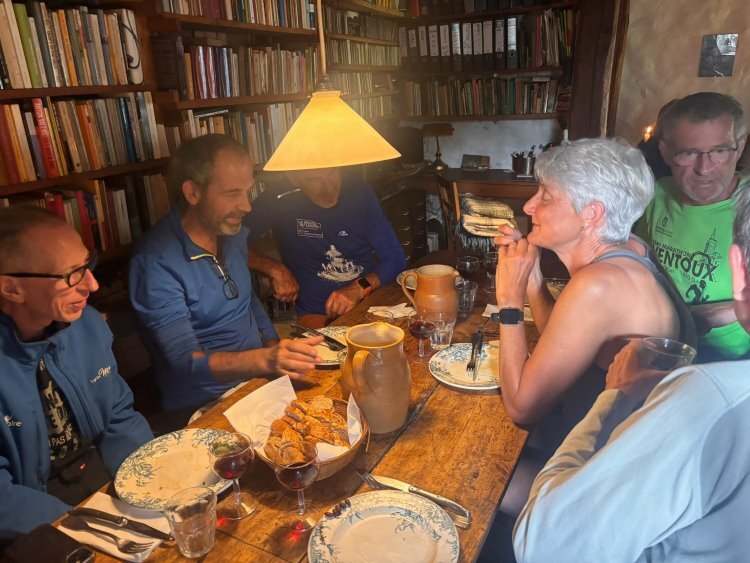
Which leads to… We walk to learn to make good choices.
One evening our spunky, 65 year old, retired film editor and Irish trail friend, Mercedes, started to talk about learning to make good choices. This is such a fractal metaphor! Did we make the right decision to walk the GR10 at all? What are the crucial things I need to do this morning before I can head out? Where should I put this foot? The next? What alternatives are there to this 26 kilometer route today and are they worth the trade-off’s, and what would we miss in terms of the specific mountain beauty of that route to make our day shorter? Do we really want to be on this trail? Should we stop to refill our water bottles at this “source?” To buy cheese and bread at this epicerie here or buy a packed lunch at the refuge? To take a short nap after lunch or push on? To try to climb this peak by a really scary route or take the contouring (but longer) route around it?
“To learn to walk” and “To learn to make good choices” lead to: We walk to learn you can only do one thing at a time, and, We walk to learn that simple tasks and simple sequences of tasks need simple systems.
For many days, I would wake each morning with a kind of brain fog. All the morning tasks I needed to do in order to get ready to put on my pack and start walking swirled in my head, none settling down to the actual doing of them. I felt paralyzed. Then one morning, I realized that I could only do one of them at a time, and that only a very few of them required a simple sequence to accomplish. For the rest, it actually didn’t matter. I could just start, and it would all fall into line. We live in a world consumed by the idea of multi-tasking and efficiency and productivity. But the truth is that we can only do one thing at a time. And for the most part efficiency and productivity are the myths of cubicle capitalism. And many of the things that have to be sequenced only require a simple system that can become routine and leave most of our time and mental energy for the more complicated and complex and creative work—the real work!—we want to do.
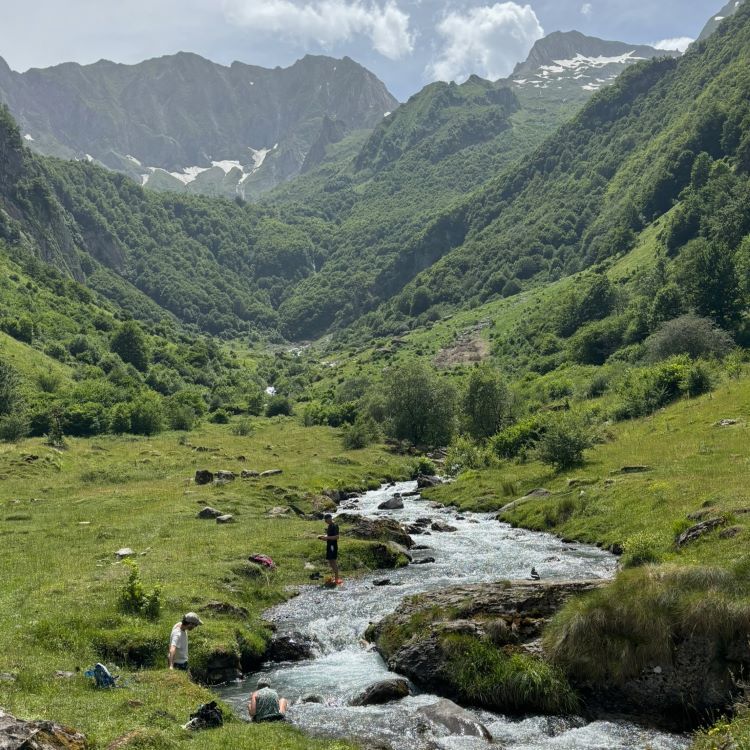
We walk to learn not to pack our fears.
At first this sounds like advice for what you put in your backpack. It is. Most of us pack too much, because we fear something might happen that would require that extra shirt or piece of wire in the repair kit or medication in the first aid kit. It’s instructive to see what people toss out or send home if they can when the weight of their packs becomes a burden they no longer want to carry. But how many of us continue to carry the backpack of fears about every little action in our lives, the internal backpack? I had so many, I realized, as the days went on! Each fear weighed me down, kept me feeling weak on the uphill or the long days. What does it mean to toss them out, or not even pack them in the first place? How much more energy did I have as I began the process of clearing them out?
And, maybe finally, though I am sure there are many more… We walk to learn to try to speak the language.
When we would talk to refuge gardien(ne)s or gîte owners, or fellow trail walkers, the first thing they would ask would often be, “Are you British?” When we said, no, we’re from California, they would react with surprise. We initially thought that was out of the horror we all were feeling about the current political situation, but then they would respond, “But Americans don’t speak French!” That was embarrassing to us, that our fellow countrypeople would be so arrogant or ignorant. We were in no way fluent, but we tried. We always started in French, even awkwardly. Sometimes people would then recognize that we weren’t native speakers and switch to English if they spoke it, or at least slow down their French, appreciative of our attempts. There is so much more to learn if you can connect with people in their own language, in their own culture, even haltingly.
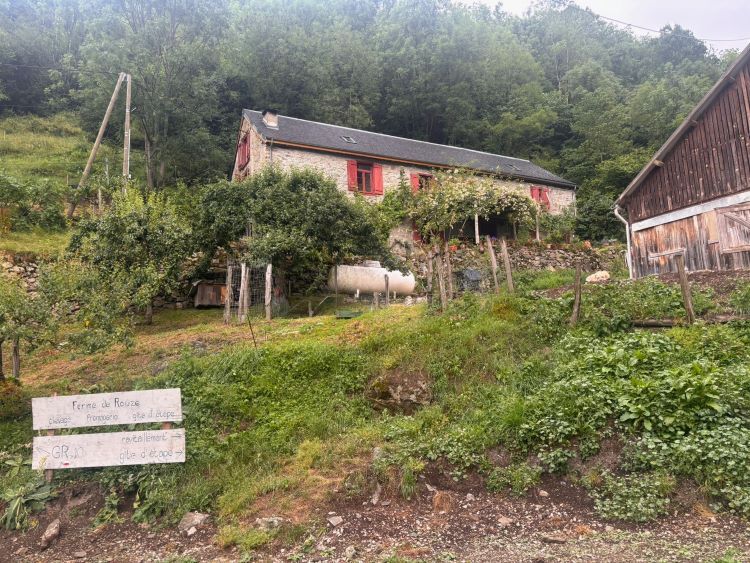
It turns out there is one more, less a metaphor than a perspective: It’s about the guidebook itself.
It goes something like this: We never thought we were “implementing” the guidebook. In part, this connects with the Oliver Wendell Holmes quote about the value of finding the simplicity on the far side of complexity, as opposed to being satisfied with the simplicity on this side. If we had had any illusions that the guidebook was a complete and detailed explanation and explication of what the trail would involve, what walking it would require us to be able to do each day, each step, we would have been disabused of that simplistic notion the first few steps we took as we left Bagnères-de-Luchon and headed up the steep trail to Artigue, in what the guidebook said was “...not much more than a rest day.” And the guidebook told us that our second day, from Artigue to Fos, would take us six hours and change; we struggled with its complexities for twelve hours, arriving at our gîte d'étape late for dinner and exhausted. For that and many other reasons, I haven’t been able to stop thinking about the metaphor of curriculum as guidebook and the implications that perspective might have for how we use adopted curricula (why do we try to “implement” a curriculum?), and for how we teach and how students learn. That’s a story for another day too.
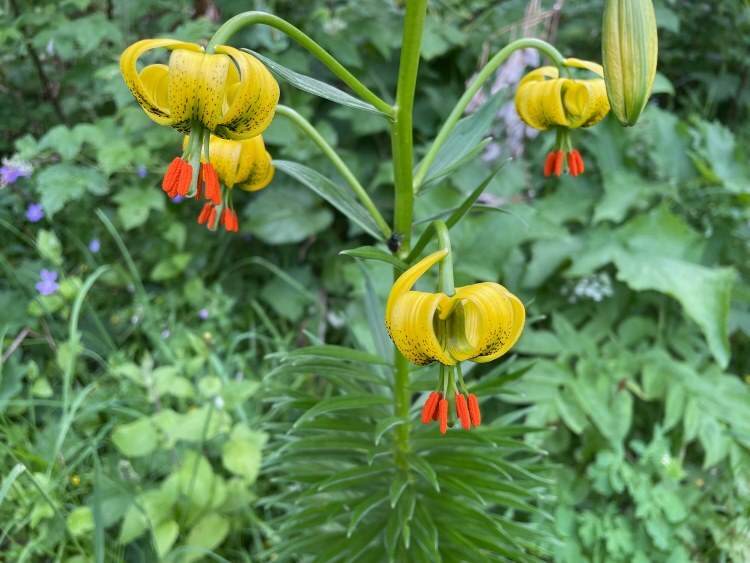
Our GR10 walk was the hardest thing we had ever done. Innovative teaching is even harder. I didn’t want us to quit hiking the GR10; I don’t want you to quit teaching. Even if, as the system is set up, it’s not sustainable, much less a place to thrive. But I want you to find a way into and through it that asks and gives you a chance to find answers to the deepest and most profound questions you have about your life and how to make it meaningful. I hope that exploring what each of these walking metaphors might mean for a long teaching career will help just a little with that quest.
All photos courtesy of the author.
John Watkins (he, him, his)
Education Coach and Consultant
John is a passionate, equity-seeking leader, with over three decades experience as a coach, consultant, evaluator, and researcher. His work supports innovative leadership that accelerates emergence; team development that brings together diverse perspectives for creative and equitable liberatory design; and complex system change in schools, school districts, and other educational organizations. He believes in slowing school down, rewilding the learning ecosystem, and recreating learning as a joyful, humane, healthy, challenging, and sustaining experience, serving its original very American purpose to support a thriving and equitable democracy.