
New Grants and an Expanding Community Propel LEAP Innovations into a New Era

Scott Frauenheim, Jessica Paulsen, Dr. Carlos Beato, and Andy Calkins
LEAP Innovations
Topics

Next generation learning is all about everyone in the system—from students through teachers to policymakers—taking charge of their own learning, development, and work. That doesn’t happen by forcing change through mandates and compliance. It happens by creating the environment and the equity of opportunity for everyone in the system to do their best possible work.
Your active participation in shaping our new era has been crucial. That is also the whole point. We all go farther when we go together. That’s as true for educators and students as it is for us and our partners.
September 1, 2026, marks six months since LEAP Innovations and Next Generation Learning Challenges (NGLC) merged our teams, resources, and communities. It has been a remarkable, and remarkably productive, half-year.
Why do we say that?
1. We joined together by leaning into the conviction that first drew us to merge and that now shapes every step we take: we must ALL be the change we seek in the world.
Learning models that explicitly help young people develop purpose, agency, capacity, and community require symmetrical operating habits, mindsets, and processes, among the adults in schools and among the partners, like LEAP, that support them.
When we announced our merger, we invited you, our communities, to tell us honestly: What do students need most right now? What would you build if you could start from scratch? What could the Next LEAP uniquely do to help? Your responses (see below) brought shape and power to our re-launch. No different than the way deep student engagement—when learners are invited to participate in that way—makes for deep, powerful learning.
2. We created a whole many times larger than the sum of our parts, by unfailingly prioritizing the job to be done (paraphrasing Clayton Christensen), rather than who created what.
LEAP and NGLC both had enormous strengths along with gaps that each of us filled for the other. Where strengths filled corresponding gaps, we celebrated; where strength met strength, we integrated without angst or regret. The resulting array of research-backed capacities now represents a complete continuum of practical, concrete district, school, and classroom supports to catalyze lasting change, from getting started to refining advanced practices, across all levels of an education ecosystem. Everything we do bridges innovation, research, and practice to help school and district partners turn student-centered innovations into sustainable classroom practice.
3. We heard a resounding “Yes!” from partners: school communities, funders, and fellow organizations alike.
Since our merger became real, LEAP has been on a roll, securing a major, multi-year grant from Crown Philanthropies along with funding from Schreiber Philanthropy, SeaChange Capital Partners, the Andrew Carnegie Foundation (through Tides Center and NGLC), and our generous anonymous donors. We are supporting thousands of students and hundreds of educators and their communities in multiple states, moving beyond our home in Chicago, with revamped and freshly integrated programs and services to address engagement and belonging, personalized learning, human-centered AI, and internal capacity building.
Your insight and wisdom are what makes the Next LEAP different. This summary of what we heard from across our community has already shaped our integrated work and continues to inform what comes next.

Credit: Distinctive Schools
Learners Need Joy, Connection, and Ownership
In our “launch week” survey last March, we asked: When you think about powerful student-centered learning, what words or phrases come to mind? Here's what you told us.
Joy. Relationships. Agency.
Voice. Choice. Curiosity. Belonging. Authentic. Meaningful. Challenging. Inquiry. Mastery. Real-world. Whole person. Multiple pathways.
These words create a portrait of what you believe learning can and should feel like for every student. As the determined changemakers who comprise the LEAP/NGLC community, the terms you used were consistent across roles and geographies, from classroom educators in Kentucky to school leaders in Chicago to a superintendent in Cincinnati to a homeschool parent entrepreneur in North Carolina. They also reflect the vision that drove the founding of both LEAP and NGLC to begin with.
When we asked, Which elements are most essential for high-quality student-centered learning today?, every single respondent selected Student agency and voice. Real-world relevance came in second followed by Strong relationships and belonging.
This consensus around the hallmarks of a student-centered learning experience has provided us with a highly-calibrated compass that is guiding all of our strategic planning and decision making.
The Future of Learning Is Dynamic, Relational, and Agentic
We also asked: If you could design a learning experience from scratch for today's learners, what would be fundamentally different? The answers again were bold and consistent. Here's the shape of the school our community would build:
Learning organized around mastery.
Say goodbye to the traditional structure of moving students of the same age through the same content at the same pace and in the same way. Multiple respondents called for mastery-based, competency-driven pathways that honor the full range of students' goals (college, career, entrepreneurship, service) and different learning styles and trajectories.
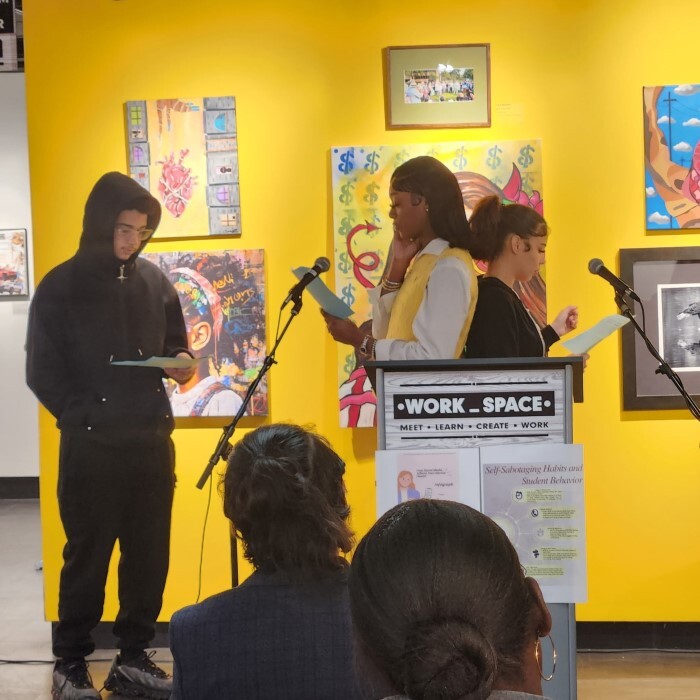
Credit: Patty Vega-Dones for Manchester Public Schools
Learning that extends beyond the school building.
One respondent put it bluntly: the best learning would likely happen outside any school building, embedded in community and built around real problems and real partnerships.
Learning built around inquiry and real-world challenges.
Respondents envisioned interdisciplinary learning organized around meaningful questions and complex problems, a clear divergence from the traditional content area silos of 8-period blocks (and faculty departments).
Students as co-designers.
Several respondents described learning that is co-constructed with learners, with teachers as facilitators rather than deliverers, and students as leaders and collaborators in their own learning.
Belonging as infrastructure, not a supplement.
As one respondent put it: "Wellness, identity, and belonging would not be add-ons; they would be central to how schools operate." Your feedback reinforces that every student must be known, connected, and supported.
This is a vision that LEAP is working with educators in our community to actively build, right now, in their schools for their learners. It’s a vision that is powerfully articulated, we couldn’t help but note, by LEAP’s central construct, the research-validated LEAP Learning Framework.

Credit: Casco Bay High School
Five Trends Defining the Future of School Design and Innovation
As we took in all of the insights we received from our innovative partners, we identified five trends that stood out to us. These trends define the moment, providing guideposts to map our next steps.
1. Agency is a core value—possibly the core value.
No concept appeared more consistently across the entire survey than agency. What struck us most was the frame respondents gave it: agency as a prerequisite for human fulfillment. In this light, you recognize learner agency as more than an innovative learning strategy; it is a right that students are owed and that our society urgently needs them to develop. Agency emerges from engagement and belonging, but only when it is explicitly supported in school and learning design.
Without naming it, respondents lifted up LEAP’s Be the Change mantra as well: Teacher empowerment and educator agency appeared alongside student agency throughout the responses. You can't build an environment of learner agency if the educators in the building don't have agency themselves. It would be like trying to run clear, pure water through rusty, decrepit pipes.
2. The human dimension of learning is always irreplaceable.
Respondents were not anti-technology, embracing AI's potential for accessibility, personalization, enabling transformation, and reducing teacher burnout. But they were adamant about what it cannot replace.
Students need "what AI cannot do,” in the words of one educator: “the human touch." Care. Joy. Being seen. A teacher who knows your name and believes in you. The "warm demander" who holds you to high expectations because they know you're capable of stretching. With so much emphasis on improving test scores, the human side of learning is often viewed as soft or irrelevant when setting improvement goals. But it’s the relationships and culture of a school that are the heart of what makes learning transformative and enduring. And they are what our network is asking LEAP to help protect.

Credit: CityBridge Education
3. The traditional architecture of school badly needs a redesign.
Your critique of traditional schooling focused on its relentless ties to instruction that is age-based, standardized, siloed by subject, and organized around seat time rather than mastery. One respondent described the challenge as "escaping a century-plus of mistaken notions" about how schools should be organized. Another named the biggest obstacle as "the way it's always been done" mindset.
What respondents called for is schooling that’s grounded in learning science. That’s what’s behind your calls for real-world relevance, interdisciplinary inquiry, mastery-based progression, co-design with students, and learning that extends into the community. We see this as strong encouragement to remain firmly planted in innovation that moves beyond improvement to more fundamental change.
4. Equity is structural, not just aspirational.
Several respondents grounded the conversation about equity in structural realities that can't be wished or workshopped away: inequitable funding, school staffing that mirrors zip code wealth, students who arrive needing resources their schools can't provide, policies that push out diverse teachers.
Equitable student-centered learning requires a vision of what’s possible AND dedication to systems change, policy engagement, movement on public narrative, and resource equity. For LEAP, this means that championing equity can't stop with teaching and learning practices. We and our communities need to shout from the rooftops and be prepared to sweat through the small stuff.
5. LEAP's highest values are as catalyst, co-designer, and connector.
When we asked what role LEAP should uniquely play, respondents described a set of functions that felt like a clear theory of change:
build networks so we can learn from each other, and to leverage the strength of numbers;
bridge gaps you identify so that you can have the tools and resources you need to succeed;
help co-design and catalyze the transformational path that’s the most effective way forward, for you and for communities like you across the country.
What our community was describing, across all of these responses, is LEAP as a co-designer—not the organization that hands down scripted models or tells schools what to do, but the one that works alongside educators and communities to help build what's possible.
That framing resonates deeply with us. It's who we aspire to be: Partners in Learning.
Our Commitments to You
Based on this invaluable feedback from our community, we make these commitments as the new, united LEAP in the year ahead.
We will put student agency and voice at the center of everything we do. If a program, resource, or partnership doesn't expand student engagement and personal agency, we'll ask why not and look for more student-centered solutions.
We will champion the human dimension of learning at a moment when it is under pressure. We will resist the pulls of technology that disrupt what only humans can offer each other. We will safely and equitably use emerging technologies to strengthen instruction, protect student thinking, and strengthen ownership of learning, and help our partners do the same.
We will work alongside you, not above you or distant from you. We see ourselves as co-imaginers of the learning experiences and systems you are building, not as deliverers of a packaged product. Your expertise, your context, your students—that's what drives the work.
We will build bridges. Between district leaders and classroom educators; between researchers and tech innovators and practitioners; between advocates who are doing this work in isolation and don't yet know each other. You told us that's where the gap is. We hear you.
We will pursue equity with urgency. That means speaking out, along with helping schools transform practice. It means showing up, live and online, for communities that need more than inspiration. And it means learning, from our partners, what policies and conditions support equity in their learning and operating models, and advocating for those policies.
We will bring joy to this work. You told us that "joyful" is a characteristic of an organization worth following. We agree! The work of transforming education is serious. But it is also full of wonder, creativity, and possibility. We promise to bring joy with abandon!
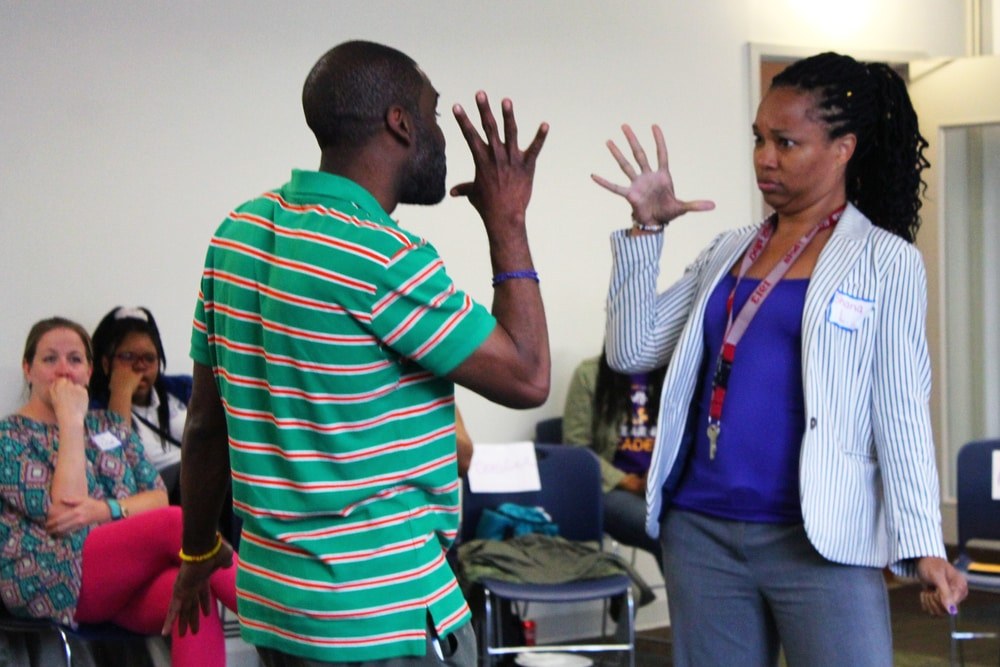
Credit: Young Audiences/Arts for Learning Maryland
All of you—the educators, partners, and others in the LEAP Innovations community—are already doing extraordinary things. You there, the Chicago schools in the LEAP Accelerator, the Kentucky district probing student engagement with the LEAP Learner Engagement Survey, the California elementary school developing personalized learning strategies, the midwest school district co-designing an AI Guidebook with your stakeholders…. You are building schools where students are known and challenged and inspired. You are working in conditions that are often difficult, with resources that are often insufficient, but you are driven by a belief that every learner deserves something better than what currently exists.
Thank you for inspiring us every day. We are here to work alongside you as partners, connectors, co-designers, and as champions of what's possible. We do that work with you hyper-locally and regionally, and also through our national presence to advance the entire field.
The next chapter is just beginning. We are humbled and we’re feeling fiercely affirmed—looking over your responses to our launch-week invitation once again—to be moving into it together with you.
Photo at top courtesy of Montessori for All
Scott Frauenheim, Jessica Paulsen, Dr. Carlos Beato, and Andy Calkins
LEAP Innovations
Scott Frauenheim is the CEO, Jessica Paulsen is the president, Dr. Carlos Beato is the chief transformation officer, and Andy Calkins is the senior partner for strategy and development at LEAP Innovations.