What’s Next in 21st Century Learning
Kristen Vogt (she/her/hers)
Senior Program Officer
NGLC
in Philadelphia, Pennsylvania
Topics
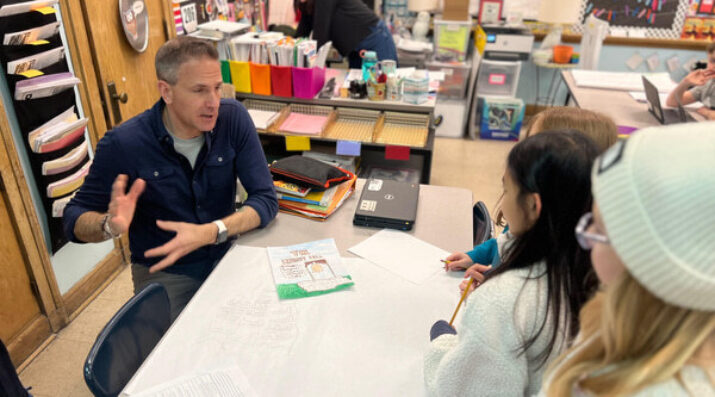
We’ve all had the experience of truly purposeful, authentic learning and know how valuable it is. Educators are taking the best of what we know about learning, student support, effective instruction, and interpersonal skill-building to completely reimagine schools so that students experience that kind of purposeful learning all day, every day.
Four topics of discussion among forward-leaning educators signal future trends in K-12 education.
We are 25 years into the 21st century. What does “21st Century Learning” look like at this turning point into the next quarter-century? These are some of the top issues that next gen educators rallied around this year on the Next Gen Learning Blog, hinting at how K-12 education will take shape in the next 25 years of the 21st Century.
More Youth Voice, Belonging, and Empowerment
From Whispers to Roars: Empowering Young People to Use Their Voice
Nika Hollingsworth, Boston Public Schools
“Empowering young people to raise their voices is not just a feel-good notion; it's critical to create a thriving and equitable educational system. When students feel heard and valued, they are more engaged in learning, and their unique perspectives can inform and improve educational practices.”
Co-Creating Classroom Norms for an Inclusive School Climate
Edward St. George, Wayfinder
“Research shows that when students play an active role in shaping their learning environment, they’re more likely to retain new information, build critical thinking and interpersonal skills, and engage more readily and deeply in learning.”
How Self-Paced Learning Creates Learner Agency for Students
Cecelia Gillam, Science Teacher
“The self-paced learning model respects individual learning styles, life circumstances, and prior learning. Self-pacing makes room for flexibility for diverse learning styles, promotes mastery over memorization, encourages ownership of learning, and reduces anxiety and comparison.”
Supporting Multilingual Learners in 2025 and Beyond: Finding the Balance between Rigor and Support
Daniel Sass and Angel Collado, Hackensack Middle School
“Any conversation around innovative student learning must begin with truly knowing students. In essence, who are we designing learning for? This conversation takes on additional layers of importance for multilingual learners, who are often labeled, stigmatized, and sequestered before they ever get an opportunity to demonstrate what they know and can do.”
AI Harnessed as a Tool for Human-Centered Learning
AI in Elementary Education: Make It Personal
Colleen Padgett, LEAP Innovations
“There’s a misconception that AI is replacing teaching, and it’s important to understand that it’s not—it’s about freeing teachers up to focus on deeper learning…. What’s exciting is that we’re actively shaping how AI tools work for our classrooms to support our personalized learning model.” – Jeff Finelli, Edison Park Elementary
AI Can Revolutionize Education, but Not in the Way We Think
Jal Mehta, Harvard Graduate School of Education
“Much of what we ask for homework is exactly what AI was made for. Read this passage, summarize the main points, and fill in a worksheet or a PowerPoint slide. Answer this algorithmic problem using the algorithm we gave you. That is basically low-level mechanical thinking, so it is not surprising that artificial intelligence is particularly well-suited to it. If you add the fact that no human being would want to do these things, it becomes a recipe for homework by Copilot. But if, instead, students are asked questions that matter to them, then they are more likely to do their own work. Relatedly, the more distinctive and original the task, the less likely that AI can provide the answer.”
Physical Spaces That Are Made for Next Gen Learning
The Importance of Outdoor Learning Spaces for Students
Paul Klee, Architect
“The outdoors can provide a full range of learning activities. Outdoor learning spaces may include gardens and horticulture, natural environmental studies, weather, solar exploration, and many more learning opportunities.”
The Collaborative Learning Commons: Physical Space and Educational Philosophy
Paul Klee, Architect
“A collaborative learning commons in schools is a dynamic, flexible space designed to support active, student-centered learning. It’s not just a place for studying or accessing resources, but a vibrant environment where students, teachers, and even community members can engage in collaboration, creativity, and problem-solving.”
A New Model of Coherent School Systems
If Your Reform Doesn’t Show Up in the Learning Lives of Kids… Did It Ever Really Happen at All?
Andy Calkins, NGLC
"Coherence becomes real only when it is seen, felt, and lived by its intended beneficiaries.... The students will tell us if real coherence is happening. We just have to ask."
7 School Design Principles for Education's Next Horizon
Sujata Bhatt, Incubate Learning, and Mason Pashia, Getting Smart Collective
“But in an age of AI and automation, a new abstraction is needed—one that values agency, adaptability, creativity, critical thinking, and the ability to learn, unlearn, and relearn. While the system reinforces the old model, this series has sought to highlight schools, districts, educators, students, and organizations at the edges who are already proving what a new, currently relevant abstraction for education could be—one where knowledge is learned in order to be able to do things in the world, rather than primarily take tests.”
Photo at top of Edison Park Elementary School, Chicago, by Molly Quinn.
Kristen Vogt (she/her/hers)
Senior Program Officer, NGLC
Kristen Vogt, senior program officer for NGLC, helps school communities tell their stories of transformation and learn about effective strategies, promising practices, and supportive conditions to transform learning. Her goal is to help school communities lead the way to a more equitable and just future of learning for our nation’s youth. Over a dozen years, she has supported school-based teams of educators, students, and key partners to build their knowledge and skills of leading transformation and has helped connect forward-leaning educators to learn with each other. She also leads the organization’s efforts to center diversity, equity, inclusion, and justice in its mission and practice.